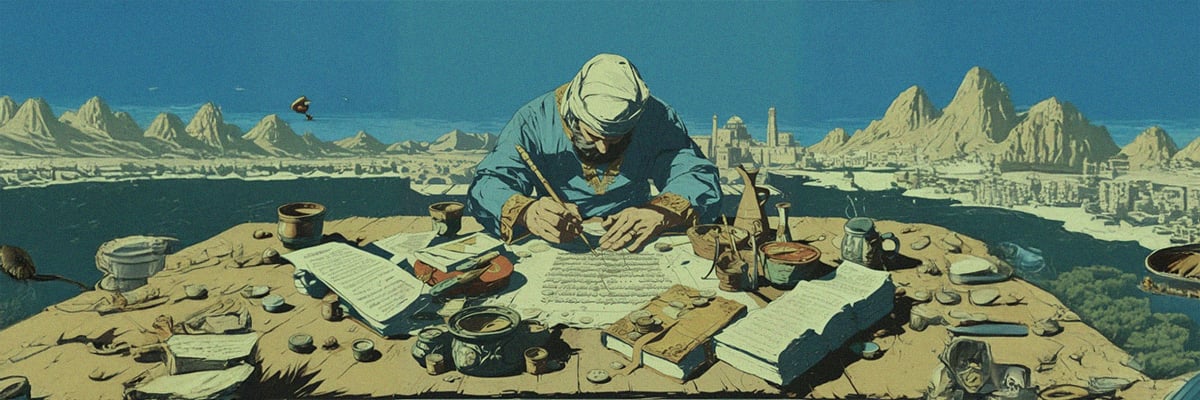

The Bayt al-Hikma (House of Wisdom), established in Baghdad under the Abbasid Caliphate, became one of the most extraordinary intellectual institutions of the medieval Muslim world. From the eighth century onward, it played a central role in the intellectual revolution that transformed Islamic civilization. The term hikma, derived from the Qur’an, signifies wisdom—an enlightened form of knowledge rooted in divine consciousness and rational inquiry.
One of the Qur’anic references to hikma appears in the supplication of Prophet Ibrahim (Abraham): “My Lord, grant me wisdom and join me with the righteous” (Qur’an 26:83). According to Qur’anic exegetes, the word hukm in this verse is interpreted as a request for vast knowledge. The pursuit of such knowledge and the rigorous inquiry that accompanies it are among the most esteemed endeavors in Islam. Thus, Bayt al-Hikma was not merely an academic institution—it was an embodiment of Islamic intellectual aspirations and a reflection of the Abbasid commitment to scholarly excellence.
The eminent scholar Dimitri Gutas, a professor at Yale University specializing in medieval Islamic history, describes Bayt al-Hikma as a library system initiated under Caliph Abu Ja‘far al-Mansur. Initially, its primary function was the translation of Persian texts into Arabic. However, during the reign of Caliph al-Ma’mun, the institution evolved beyond its initial mandate and expanded into fields such as mathematics and astronomy, becoming a center for scientific inquiry.
More than just a translation center for ancient Greek and Roman texts, Bayt al-Hikma functioned as a hub for interdisciplinary scholarship. It attracted some of the most brilliant intellectuals of the time, fostering an environment where ancient and contemporary knowledge could be synthesized and expanded. The first Arabic translation of Aristotle’s Physics was completed within the walls of this institution.
Al-Ma’mun, the son of Caliph Harun al-Rashid, was deeply committed to the advancement of knowledge. A scholar in his own right, he recognized the immense value that Islam placed on learning. His vision was to bring the world’s diverse intellectual traditions to Baghdad, analyze them, and propel new discoveries. Under his patronage, Bayt al-Hikma flourished. He appointed renowned scholars such as Hajjaj ibn Matar, who translated Euclid’s Elements into Arabic, and the celebrated mathematician Muhammad ibn Musa al-Khwarizmi, who conducted full-time research at the institution.
Al-Khwarizmi, often considered the father of algebra, acknowledged the direct influence of al-Ma’mun in the introduction to his groundbreaking work Hisab al-Jabr wal-Muqabala (The Book of Calculation by Completion and Balancing). He wrote: “It was Caliph al-Ma’mun who encouraged me to compose this comprehensive work on algebra, which addresses calculations in surveying, trade, inheritance distribution, estate division, and canal construction.”The physical structure of Bayt al-Hikma was an architectural marvel, located in close proximity to the royal palace. Surrounded by lush gardens, it provided an ideal setting for scholars to engage in deep contemplation, conduct research, and compose their works in an atmosphere of intellectual freedom.
Departments and Functions of Bayt al-Hikma
The institution operated through six primary departments:
1. Preservation of Ancient Manuscripts: A vast collection of historical texts was safeguarded within its library.
2. Access to Scholars: Books were made available for research and study by qualified scholars.
3. Copying and Binding of Books: Manuscripts were meticulously transcribed and preserved for future generations.
4. Authorship and Documentation: Scholars were encouraged to write new works and refine existing ones.
5. Translation of Classical Works: Texts from Greek, Persian, Sanskrit, and Syriac were rendered into Arabic.
6. Creation of Original Research: Bayt al-Hikma was not merely a repository of knowledge but a center of innovation, where pioneering works were produced in various fields.
The institution was financially supported by waqf endowments, book sales, and, most significantly, the generous patronage of the Abbasid caliphs. They recognized that the greatest wealth was knowledge, and they spared no expense in fostering its development.
Fields of Study and Scholarly Contributions
The breadth of scholarship at Bayt al-Hikma was remarkable. Research was conducted in disciplines ranging from astronomy, medicine, and engineering to history, geography, and mathematics. The Abbasid caliphs incentivized scholars by offering gold coins in proportion to the length of the translated texts. However, they did not merely encourage translation; they also promoted original scholarship. Over a hundred scientific disciplines took root in Bayt al-Hikma, and its intellectual influence soon spread to other Muslim regions.
Parallel to the development of Bayt al-Hikma in Baghdad, similar institutions emerged in different parts of the Muslim world.
Other Centers of Learning Inspired by Bayt al-Hikma
From the eighth century onward, three major centers of learning followed in the footsteps of Bayt al-Hikma:
1. Bayt al-Hikma of Tunisia – Established in the ninth century by Amir Muhammad al-Galabi in the city of Raqqada, this institution was modeled after its Baghdad counterpart. The amir, a passionate patron of knowledge, visited Bayt al-Hikma in Baghdad, where he acquired numerous manuscripts, books, and scientific instruments. Each year, he made additional trips to expand his collection, eventually forming one of North Africa’s most significant libraries.
2. Dar al-Hikma of Al-Andalus – Founded in tenth-century Muslim Spain by Caliph Al-Hakam II, this institution became one of the most celebrated centers of learning in Cordoba. Known as the Scholar-Caliph, Al-Hakam II amassed an unprecedented collection of books, surpassing any ruler before him. His ambition was to preserve and expand knowledge in all domains, from science to the arts. It was under his patronage that Al-Andalus flourished as a hub of intellectual brilliance, rivaling even Baghdad.
3. Dar al-Hikma of Cairo – In tenth-century Cairo, the Fatimid Caliph Al-Aziz Billah, a devoted scholar and bibliophile, established Dar al-Hikma. His collection included every work that had been produced at Bayt al-Hikma in Baghdad. He ensured that scholars had unrestricted access to these texts and provided free ink, pens, and paper to facilitate their research. The intellectual resurgence in Cairo owed much to this institution, as it provided the necessary infrastructure for scholars to engage in rigorous academic inquiry.
The Fall of Bayt al-Hikma
For centuries, Bayt al-Hikma remained a bastion of intellectual activity, fostering scientific advancement and disseminating knowledge across the Muslim world. However, its golden era came to a tragic end in AD 1258 when the Mongols, led by Hulagu Khan, sacked Baghdad. In what was one of the most devastating acts of cultural destruction, the Mongols set fire to Bayt al-Hikma, reducing its vast repository of knowledge to ashes. According to some historical accounts, they used its books to create makeshift grain silos, while others suggest that countless manuscripts were thrown into the Tigris River, turning its waters black with ink.
Despite this catastrophic loss, the knowledge cultivated at Bayt al-Hikma had already spread to other parts of the Muslim world and Europe. Many of its texts had been copied and transferred to institutions in Cairo and Cordoba, while numerous translations into Latin had been completed by European scholars. In this way, Bayt al-Hikma played a pivotal role in the transmission of knowledge that later fueled the European Renaissance.
The House of Wisdom may have perished, but its intellectual legacy endures. It stands as a testament to the heights of scholarly achievement that a civilization can reach when it values knowledge as its greatest treasure.