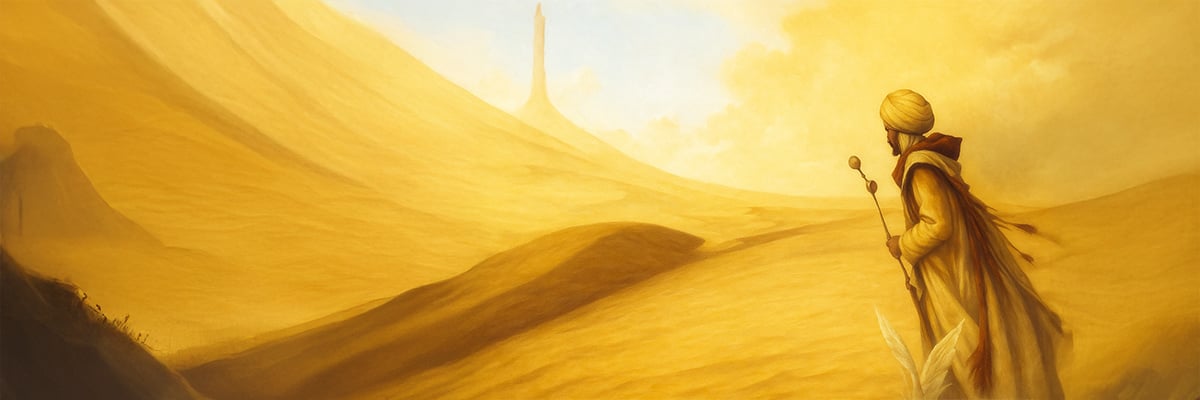

In an era when hedonistic luxury had become the very breath of Umayyad rule, a new designation emerged from the spiritual depths of Islam—the term "Sufi." Etymologists, like explorers charting unknown territories, have navigated this word through vast harbors of meaning, each interpretation adding another layer to its significance. Yet within the boundaries of Shariah, it blossoms into an exquisitely beautiful experience.
Sufism is that spiritual alchemy which restrains humanity from all evil, kindles the flame of divine remembrance in the heart, and refines the soul into its purest form. This sacred tradition, passed from Prophet Adam through all the prophets until it reached the Seal of Prophets Muhammad (peace be upon him), and from him to his companions, existed then as a nameless reality—a truth without label. As Yusuf al-Nabhani notes in his "Jami' Karamat al-Awliya," the very word "Sufi" only became familiar after the year 200 Hijri.
The etymology of "Sufi" has sparked diverse scholarly opinions. Some trace it to "suf" (wool), pointing to the humble woolen garments these seekers wore as emblems of humility. Others derive it from "saff" (row or rank), suggesting that Sufis stand in the front ranks of divine proximity. Another theory links it to "suffa" (piece of wool), indicating those who patched torn garments, caring nothing for worldly life. Some connect it to "safa" (purity), describing hearts cleansed of worldly thoughts.
The movement itself is called "Tasawwuf," anglicized as "Sufism."
Dhun-Nun al-Misri defined Tasawwuf simply: "To prefer Allah above all things." Imam Suhrawardi, in his "Awarif al-Ma'arif," described it as "the light that forms in the heart from acting according to the Quran and Sunnah." He noted that while nearly a thousand definitions of Tasawwuf exist, they all converge on one essence: a magnificent life that begins with Shariah, progresses through spiritual training, abandons worldly distractions and selfishness, and ultimately finds rest in the Supreme Truth.
When Sufism Faced Opposition
The historical trajectory of Sufism reveals a fascinating pattern: scholars who initially opposed it with every fiber of their being later became its most ardent standard-bearers.
After the Companions passed away, material gateways swung wide open before Muslims. People became entranced by worldly allure, their religious devotion waning like a dimming flame. Yet devout believers remained, unwavering in their faith. They turned away entirely from the material world, immersing themselves in worship. Their extreme aversion to materialism led them to impose upon themselves forms of worship unknown to their predecessors.
In this climate, a semi-Shi'ite group calling themselves "Sufiyya" emerged in Kufa, advancing dangerous doctrines such as declaring the entire world forbidden without a just ruler. Moreover, Persian influences, Greek philosophical thought, and Judeo-Christian worship practices gradually infiltrated Sufi pathways. A veritable flood of un-Islamic elements became apparent.
This strained relations between scholars and Sufis, subjecting Sufism to fierce criticism. It was in this context that Imam Shafi'i's harsh words must be understood: "One who becomes a Sufi in the morning becomes a fool by noon," and "Whoever associates with Sufis for forty days will never regain his sanity." We must recognize that Islam's enemies were exploiting Sufism as a veil to distance people from Ahl al-Sunnah.
Sufism and Ahl al-Sunnah Reconciled
After the Rightly-Guided Caliphs, Islamic governance transformed into dynastic rule, with power falling into unworthy hands. These rulers needed scholars for legal judgments, but God-fearing scholars kept their distance, knowing they might be forced to issue religious rulings according to rulers' whims. They understood that association with such authorities would obstruct a life lived according to religious principles. Nevertheless, rulers made countless attempts to win them over.
This dynamic profoundly affected emerging generations. Countless individuals, coveting position and status, entered the scholarly arena. Religious-minded people lost respect for scholars, and believers began despising those who prostrated before rulers. Meanwhile, sincere scholars withdrew, dedicating themselves to developing jurisprudence. They stepped forward to open spiritual pathways for authentic Islamic ideals and values.
With encouragement from rulers like Nur al-Din and Salah al-Din, khanqahs flourished alongside madrasas. Thus Sufism entered the mainstream of Ahl al-Sunnah.
Sufism transformed into a movement proper during the ninth century. When Umayyad-era conflicts and other factors dimmed Islam's radiance, Sufism acquired its revivalist character. Until the twelfth century, the spiritual path remained individualistic. In the thirteenth century, it gained organized form through orders like the Suhrawardiyya, Qadiriyya, Rifa'iyya, Chishtiyya, Shadhiliyya, and Badawiyya. By the late eighteenth century, Sufism regained its dynamism.
However, challenges emerged. Shrines and khanqahs transformed into centers exploiting divine blessings. While Sufi celebrations (mawlids) remained accessible, life transformation became rare. The reforms of the Wahhabi movement originating in Najd disrupted Sufism's rhythm. From this crucible emerged figures like Ahmad Tijani, Abu Hamid al-Barghawi, Ahmad ibn Idris, Ali al-Sanusi, and Shah Waliullah, who stood at the forefront of efforts to restore Sufism's golden age.
This is the story of Sufism—born from the purest springs of prophetic tradition, tested in the fires of opposition, refined through centuries of spiritual struggle, and perpetually seeking to return to its luminous origins. It reminds us that authentic spirituality often faces its greatest challenges not from external enemies but from those who would exploit its sacred name for worldly gain. Yet through every trial, the genuine seekers—those who truly empty their hearts of all but Allah—continue to carry forward this noble tradition, ensuring that the light of spiritual realization never dims in the house of Islam.