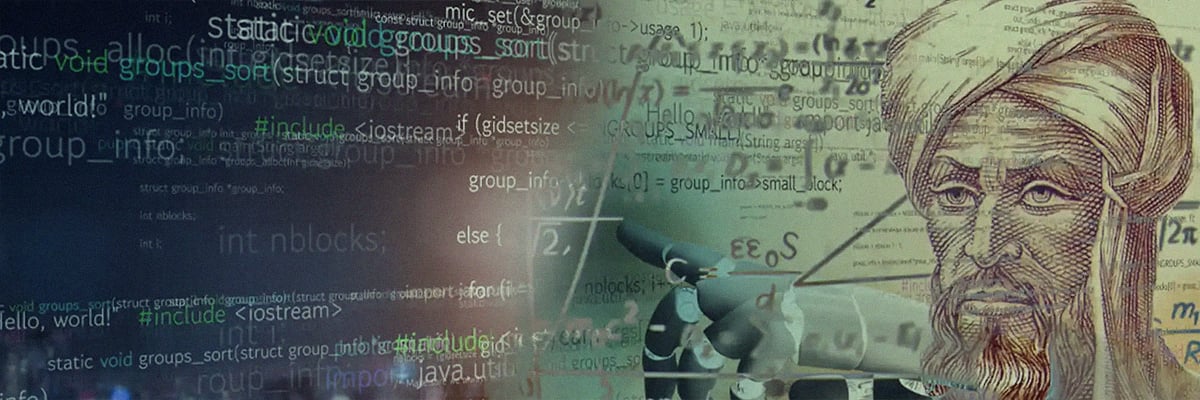

The medieval period witnessed groundbreaking advancements in mathematics, with some of the most profound contributions coming from Muslim scholars. Among them, the Persian polymath Al-Khwarizmi stands out as a pioneering figure whose work laid the foundation for algebra. His seminal treatise, Kitab al-Mukhtasar fi Hisab al-Jabr wal-Muqabala (The Compendious Book on Calculation by Completion and Balancing), established algebra (al-jabr) as an independent discipline, marking a transformative shift in mathematical thought. While Greek mathematicians had primarily focused on geometry, Al-Khwarizmi introduced a revolutionary framework that allowed for the systematic solving of equations.
Algebra, as developed by Al-Khwarizmi, provided a unified system for mathematical operations, including measurements, structures, and relationships. His innovations extended the applicability of mathematics beyond its traditional domains, enabling it to be used in fields where it had not previously been applied. Following his contributions, every subsequent development in mathematical theory was built upon the foundation of algebra.
In the years that followed, another Persian mathematician, Al-Karaji, further refined Al-Khwarizmi’s ideas. He liberated algebra from its earlier dependence on geometric principles and introduced arithmetic-based methods, which remain in use today. It was Al-Karaji who first formulated the notations x, x², x³, and similar mathematical symbols, which have since become standard in algebraic expressions. Recognizing the importance of education in advancing mathematical understanding, he also established some of the first schools dedicated to the study of algebra.
Two centuries later, in the twelfth century, the mathematician Al-Samawal Yahya expanded on these principles. He developed rigorous methods to apply algebra across various fields of study, significantly broadening its scope. Another major contributor to algebraic theory was the renowned scholar and poet Omar Khayyam. While he is best known for his Rubaiyat, a collection of Sufi-inspired quatrains, his mathematical research was equally remarkable.
Khayyam focused on classifying cubic equations, systematically deriving solutions that allowed for a more comprehensive application of algebra. His investigations were later refined by Sharaf al-Din al-Tusi, another twelfth-century scholar, who explored the use of algebraic equations in the study of curves. Al-Tusi’s work laid the groundwork for algebraic geometry, a field that would later see extensive development.
While algebra was experiencing a revolution, parallel advancements were occurring in other branches of mathematics. The ninth-century scholars known as the Banu Musa—three brothers based in Baghdad’s Bayt al-Hikma (House of Wisdom)—were among the foremost mathematicians of their time. Their expertise extended beyond theoretical mathematics, as they also engaged in the design and construction of mechanical devices.
One of their most gifted students was Thabit ibn Qurra (born in AD 836), whose contributions to number theory were particularly significant. His work led to the formulation of the concept of amicable numbers, which later became a key area of mathematical study.
The theory of amicable numbers gained further refinement in the thirteenth century through the efforts of Kamal al-Din al-Farisi. He identified 17,296 and 18,416 as an amicable pair—an insight that was later expanded upon by the Swiss mathematicians of the eighteenth century.
By the tenth century, Muslim mathematicians had reached unprecedented heights in mathematical inquiry. Ibn al-Haytham, best known for his contributions to optics, also made remarkable advances in number theory. He formulated the 2k - 1 theorem, which anticipated later developments in prime number research. His work directly influenced the English mathematician John Wilson, who, in the eighteenth century, developed Wilson’s theorem—stating that for any prime number p, (p - 1)! ≡ -1 (mod p). This theorem, however, traces its origins to Ibn al-Haytham’s discoveries centuries earlier.
Beyond theoretical advancements, mathematics played an essential role in commerce and economic transactions. Accurate methods for counting, addition, and subtraction were crucial for trade. The introduction of zero was a groundbreaking innovation that allowed for the simplification of multiplication and division, making complex calculations more accessible. This concept, which originated in India, was refined and integrated into mathematical practice by Muslim scholars, leading to the development of the Arabic numerical system. By the tenth century, this system had been adopted in Europe, replacing cumbersome Roman numerals.
The spread of Arabic mathematics into Europe occurred through three primary channels. First, Gerbert of Aurillac (later Pope Sylvester II) traveled to Spain in the late tenth century to study under Muslim scholars. He later introduced Arabic numerals and mathematical techniques to Rome. Second, Robert of Chester translated Al-Khwarizmi’s works from Arabic into Latin, making them accessible to European mathematicians. Third, Fibonacci, the renowned thirteenth-century mathematician from Pisa, acquired his mathematical education in Algeria. He studied under the expert Sidi Umar and traveled to libraries in Cairo and Alexandria before writing his influential book, Liber Abaci, in which he introduced Arabic numerals to Europe. The modern historian Karl Menninger, in his book Number Words and Number Symbols, documents these historical connections in detail.
During the medieval period, mathematics flourished under Muslim patronage, transforming into a highly advanced discipline. With the introduction of zero, new concepts such as square roots and decimal calculations emerged. Scholars like Abu’l-Wafa and Omar Khayyam played instrumental roles in these developments. In the fourteenth century, Jamshid al-Kashi of Samarkand made significant contributions to decimal fractions, a concept that later influenced European mathematicians such as Ruffini and Horner in the nineteenth century.
The contributions of medieval Muslim mathematicians were far-reaching, shaping the future of algebra, number theory, and mathematical computation. Their innovations were not merely theoretical but had profound practical implications, enabling advancements in engineering, astronomy, and commerce. By systematically refining mathematical concepts and methods, they laid the intellectual groundwork upon which modern mathematics continues to build.