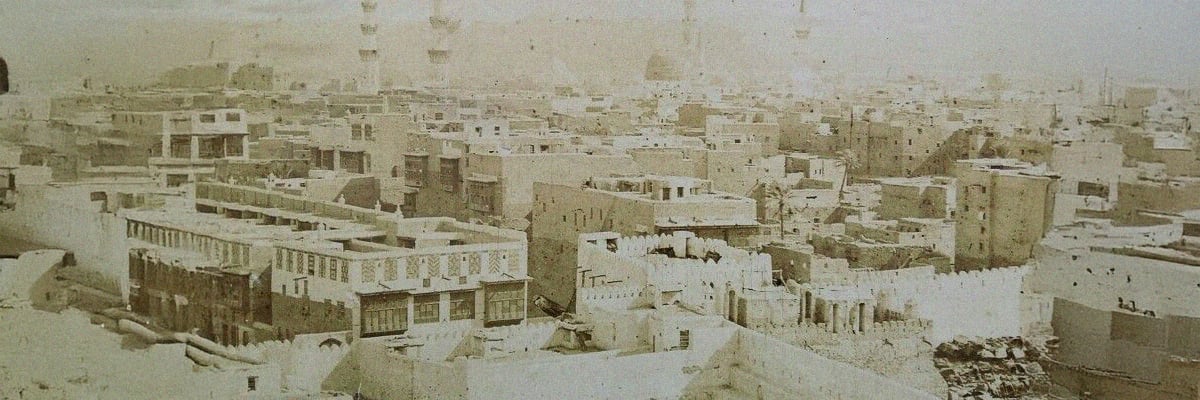

It was the tenth year of the Hijra. A sudden piece of news spread across Madinah and its surrounding regions: the Prophet ﷺ would be performing Hajj this year, and anyone who wished could accompany him. The news spread like wildfire. Everyone began preparing—without wasting even a moment. The group preparing for this Hajj consisted of women, children, men, the elderly, and even pregnant women. No one was forced or specially encouraged; yet they gathered naturally, driven by a single longing in their hearts: to perform Hajj alongside the Prophet ﷺ.Even though it would be a ten-day journey from Madinah to Makkah, no one considered it is a hardship. For the joy of living and traveling with the beloved Prophet ﷺ outweighed all fatigue and difficulty. About 130,000 companions accompanied the Prophet ﷺ from Madinah. Many more joined along the way. As soon as people from various villages heard about the caravan, they hurried to the Makkah-Madinah route to wait for the Prophet ﷺ and join him. Together, they moved towards Makkah. After the long journey of ten days, the caravan reached Dhul-Tuwa, just outside Makkah. It was the night of Sunday, the fourth of Dhul-Hijjah. They camped there that night. Early the next morning, after performing the ritual bath (ghusl), the Prophet ﷺ and the massive crowd set out toward Makkah. They had already completed all the rituals except the most significant act: standing at Arafat. The plain of Arafat overflowed with pilgrims clothed in their simple, pure garments.
When the sun had passed its zenith, the Prophet ﷺ set out on his camel toward Arafat. All eyes were eagerly awaiting his arrival. The Prophet ﷺ rode toward Wadi Urnah, a slightly elevated area near Arafat. From atop his camel, he delivered a sermon unlike any the world had ever heard. This sermon was a condensed essence of his 23-year mission. It was an answer to the question: What is Islam? It was a declaration of humanity’s duty. It was the most vital message for every human being. It buried all darkness beneath the ground and proclaimed the light. It marked the first human rights declaration in history, laying out the rights of every individual, great and small. This was also the Prophet’s ﷺ Farewell Sermon. His mission had begun in Makkah, and he had spent the prime of his life there. Thus, it was fitting that he bade farewell to his followers here—at a grand assembly—and officially declared the completion of Islam at Arafat, the window to the world, where Muslims gather annually. Standing atop his camel, the greatest lover of humanity the world has seen, Prophet Muhammad ﷺ, proclaimed the rights of all humankind. Hundreds of thousands of people bore witness. Rabi’ bin Umayyah echoed the Prophet’s ﷺ words to ensure they reached the entire crowd. Thus began the Farewell Sermon, the Proclamation of Human Rights, and the Declaration of the Completion of Islam:
“O People!
Listen to me carefully. I may not be with you here again after this year. Your lives and your honor are sacred to each other, as sacred as this day, this month, and this land. All acts of revenge stemming from the Age of Ignorance (Jahiliyyah) are hereby abolished. First, I nullify the claim for revenge for the blood of Rabi’ah, son of Harith, son of Abdul-Muttalib. After me, do not return to disbelief by striking each other’s necks.
O People, know this: Your Lord is One, and your father is one. You are all descended from Adam, and Adam was from dust. There is no superiority for an Arab over a non-Arab, nor for a non-Arab over an Arab. Neither for a white person over a black, nor for a black person over a white—except through righteousness and piety. Have I conveyed this message to you?
(The people replied): Yes, O Messenger of Allah!”… “Witness , oh Allah , witness”
“O People!
You have rights over your women, and they have rights over you. Fear Allah regarding your women, for you have taken them as a trust from Allah. Their chastity is protected by the word of Allah. You are required to provide them with food and clothing in kindness. Do not introduce anyone to their beds except yourselves.
O People,
Your wealth and lives are sacred, as sacred as this day, this month, and this city. Whoever is entrusted with something, he must fulfill his trust. All forms of usury (riba) are abolished, even that of the pre-Islamic era. You are entitled to your principal amounts only. You shall neither inflict nor suffer any injustice. Allah has decreed that there shall be no usury. The first usury I abolish is that owed to my uncle, Abbas bin Abdul-Muttalib.”
The Prophet ﷺ asked again: “Have I conveyed the message?”
(The people replied) “Yes, O Messenger of Allah.”
“Then let those present convey it to those absent.”
Human Rights in Islam: A Historical Overview
In the Islamic world, the concepts of “Haq” and “Huquq”—rights—have always been among the most discussed. Islam was the first religion to systematically grant rights to every entity in creation, animate or inanimate.
After the Quran and the Prophet ﷺ spoke extensively about rights, the world had to wait for over one and a half millennia to hear similar declarations elsewhere. Sadly, for centuries, non-Muslim societies resisted internalizing these human rights. Over the past twelve centuries, the world has witnessed oppression across many fronts—against slaves, people of color, women, the working classes, and religious minorities. Islam protected all these groups and elevated them to positions of dignity within society.
Outside Islam, however, people had to fight long, bloody struggles to claim their rights. Abolitions of slavery and the rise of feminism, for example, came only after intense revolutions and upheavals. Islam and the Prophet ﷺ, by contrast, served as models of rights-based justice in an era when the world at large remained unaware of the very concept of rights. Fourteen centuries ago, Islam taught that every human being is entitled to innumerable rights.
The Prophet ﷺ demonstrated it through his own life. These rights were not confined to paper; they were fully realized within the Muslim community. Each individual could experience their dignity and rights tangibly. The Prophet ﷺ came to uphold and protect human rights. Establishing these rights was one of Islam’s primary goals. The Farewell Sermon at Arafat was the grand culmination of this project, a majestic proclamation in the presence of hundreds of thousands of believers—people from different tribes, races, and regions, all dressed alike and chanting the same prayers.
The Broader Historical Context
Encyclopedia Britannica and other Western academic sources record that the notion of human rights gained mainstream attention only after World War II. Yet Islam had been teaching these principles 1400 years earlier. It is a historical injustice that many historians remain unaware of, or ignore, the fact that human rights were already systematically enshrined by Islam long before the Renaissance or modern revolutions. While the French Revolution is often cited as a milestone in human rights history, its famous slogans had already been deeply familiar to the Islamic world centuries earlier. Even Rousseau’s famous words—“Man is born free, but everywhere he is in chains”—echo sentiments declared by the second Caliph Umar (RA) to the world centuries before Rousseau was born.
Many of the words and concepts celebrated today as original innovations were actually borrowed, knowingly or unknowingly, from Islamic teachings. In non-Islamic societies of the past, rights were concentrated in the hands of the elite, while common people were treated as tools for their rulers. Other religious traditions had little or nothing to say about human rights. The Western world saw the emergence of rights-based revolutions only from the 16th century onward, giving rise to what is called the Renaissance. Before that, concepts like freedom and human dignity were largely absent.
The Prophet ﷺ, however, did not preach human rights as political slogans but as Divine mandates—rights to be protected through faithful practice, not rebellion. The much-celebrated Magna Carta of 1215, often hailed as the first human rights document in Europe, was, in reality, merely a charter to protect the feudal lords and landowners. As Henry Marsh pointed out in Documents of Liberty (MW Books, England, 1971, p.51): “The Magna Carta was no more than a charter of landlords and feudal lords.”
Even after the Magna Carta, the masses remained largely disenfranchised for centuries. The full awareness of human rights among ordinary people only began to emerge gradually during the Renaissance, as noted in the International Encyclopedia of Social Sciences and The New Encyclopedia Britannica.
The Islamic Conception of Human Rights Islam embraced human rights as a central part of its divine mission 1400 years ago. Its goal was to enable people to live freely, fearing none but Allah. This is why Islamic legal theory (Maqasid al-Shariah) evolved: the protection of life, intellect, family, faith, dignity, and wealth.
Technically referred to as “al-Kulliyyat al-Sitt,” these five essentials must never be violated in Islamic law or worship. Islam’s arrival was fundamentally about protecting human beings and their rights. Thus, even in his final sermon, the Prophet ﷺ emphasized human rights.
In Islamic governance, rights were not granted as concessions from rulers to people, but as divine endowments from Allah. The Quran explicitly states: “Indeed, We have honored the children of Adam.” (Surah Al-Israa, 17:70) Thus, these rights are not favors from kings or rulers, nor are they fragile gifts to be feared lost. They are inviolable grants from the Creator.
In Islam, every person is equal and entitled to dignity, and no one has the right to infringe upon these divine rights. A Comparison with Modern Declarations Many consider the Universal Declaration of Human Rights (UDHR), adopted by the United Nations on December 10, 1948, as the greatest human rights proclamation the world has seen. However, a careful reader of the Prophet’s ﷺ teachings will realize that the principles laid out in the UDHR were already articulated 1400 years ago by him.
The UDHR, despite its lofty ideals, remains more a collection of aspirations than enforceable laws. The UN lacks the power to implement it across the world. In contrast, Islam embedded human rights as inseparable aspects of faith and practice. Every Muslim was required to uphold them, and the Prophet ﷺ demonstrated their implementation through his own life and leadership.