
Truly generous souls are those who put others before themselves—even in need.
To give and keep something back is called charity.
But to give more and keep back only what is necessary—that is generosity.
The Qur’an speaks of such people with awe:
Even if poverty strikes them, they still give others preference over themselves.
(59:9)
One day, a woman approached al-Layth ibn Saʿd and asked for a bit of honey.
He didn’t hand her a spoonful.
He gave her a large vessel full.
People around him frowned.
But he calmly replied,
“She asked according to her need. I gave it according to my capacity.”
Let us recall another two stories.
Both from the history of Islamic civilization.
Both about generosity that blinds the eye with wonder.
The first is from the life of ʿAbdullāh ibn Jaʿfar (رضي الله عنه).
He was walking through a plantation in the countryside when he spotted a servant working in the fields.
As the servant sat down to eat, a stray dog wandered up, hungry.
The servant tossed it a piece of bread.
The dog lingered, staring again.
He gave it another piece.
Then a third.
The dog ate it all.
Ibn Jaʿfar, astonished, walked over.
“How much bread do you receive daily?”
“What you just saw,” the servant replied. “That’s my full meal.”
“Then why did you give all of it to the dog?”
“There are no other dogs around here. This one must have traveled far in hunger. I couldn’t bear to eat while it watched.”
“And what will you eat today?”
“Nothing,” the man smiled. “I’ll go hungry.”
Ibn Jaʿfar was moved beyond words.
“People call me generous,” he whispered, “but my generosity cannot stand in the shadow of this man’s mercy.”
He immediately bought the entire orchard, the tools, and the servant’s freedom.
And then gave all of it to him as a gift.
Now the second story.
Someone once asked Qays ibn Saʿd ibn ʿUbādah (رضي الله عنه):
“Do you know anyone more generous than yourself?”
“Yes,” he said without hesitation.
And he told this tale:
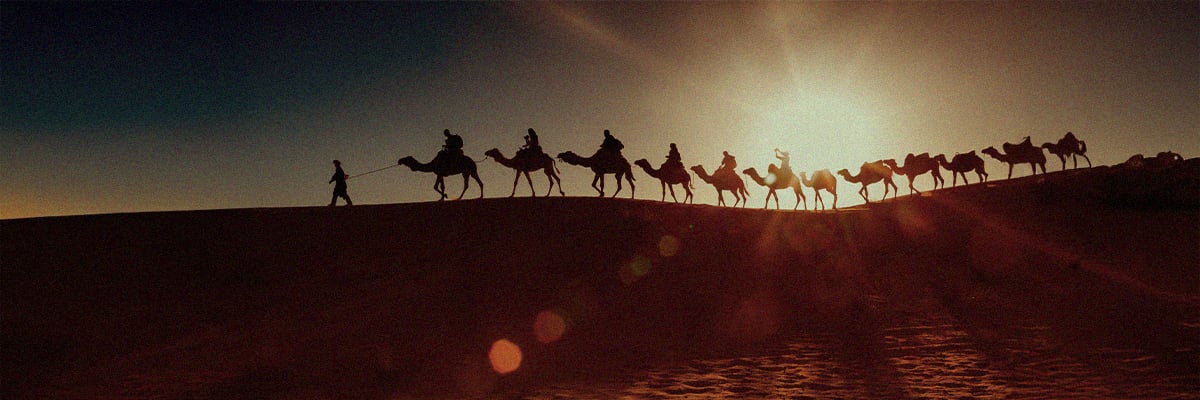
“We were traveling through the desert when we stopped at the tent of a Bedouin woman. Her husband returned home, and she said, ‘We have guests.’ Without hesitation, he slaughtered a camel for us.
The next day, he did the same.
‘This is for you,’ he said, smiling.
We objected, ‘But you hardly gave us anything from the one you slaughtered yesterday.’
‘I don’t serve my guests old meat,’ he said with pride.
We stayed for two or three days—each day he offered a new camel.
Before leaving, we handed the wife 100 dīnārs in secret and said,
‘If our presence has caused you hardship, please tell your husband. Let him forgive us.’
We departed.
But before long, we heard him behind us—shouting in anger. He ran toward us, waving his hands.
‘You wicked men! Are you trying to put a price on my hospitality?!’
He hurled the money back and roared:
‘Take it. Or I swear by this spear, I’ll drive it through your hearts!’
We had no choice but to accept it back.
And then he sang:
If someone tries to repay my generosity with gold,
Let that gold weigh me down with shame for the rest of my life.
To the truly generous, guests are not a burden.
They are divine visitors, sent by God Himself.
Mutarrif ibn al-Shakkīr (رحمه الله) once said:
“If anyone among you ever needs something from me, just send me a note. Don’t come in person. I can’t bear to see the poverty on your face.”
And Shaykh Abū ʿAbd al-Raḥmān al-Sullamī (رحمه الله)?
He would never give charity by hand.
Instead, he would place it on the ground and ask the other to pick it up.
Why?
He explained,
“I cannot bear for my hand to rise above another’s. This world isn’t worth that much.”
This is the essence of real generosity—
To give without hesitation.
To protect the dignity of the receiver.
To measure not how much you gave, but how much you held back.
And when someone calls you generous, ask yourself:
Would you still give like that… if no one ever knew?
If the one in need were not your kin, not your friend—not even your kind?
Then perhaps, somewhere in the world, there walks someone more generous than you.