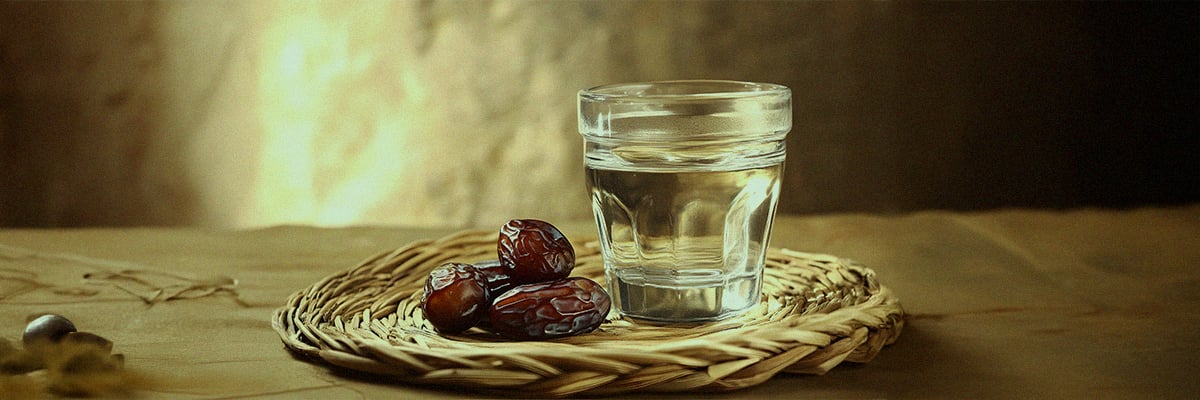

A grand feast is laid out before him. The table is adorned with delicacies that would make any fasting soul’s heart race with anticipation. The hunger gnaws deep, the thirst parches the throat—it has been a long day of fasting, after all. This is not an ordinary meal. When the fast is broken, there is a unique joy, a longing that only the fasting person understands. Is it not the Prophet ﷺ himself who said, “For the fasting person, there are two joys: one when he breaks his fast and one when he meets his lord”?
And yet, here he sits, staring at the lavish spread, unmoving. Tears stream down his face, unstoppable. He cannot bring himself to eat. His mind is lost in old stories—memories from a time long past.
He was once an extraordinarily wealthy man. A man with an uncanny eye for trade, a Midas touch that turned everything to gold. One day, a sudden commotion in the streets of Madinah. A thunderous procession shakes the very ground. A caravan of 700 camels arrives, laden with goods from Syria and Egypt. A vast array of fabrics, grains, and spices—an overwhelming display of wealth. The people marvel in awe.
And yet, the entire fortune belonged to just one man: the wealthiest of the wealthy—ʿAbd al-Raḥmān ibn ʿAwf.
But he had not always been this way.
When he first set foot in Madinah, he arrived empty-handed. No home, no belongings, no family. He had left behind his birthplace for one reason alone: faith. He was among the Muhājirūn—those who had migrated for the sake of belief, abandoning all they knew. But in Madinah, the Anṣār welcomed them, each Muhājir paired with an Anṣārī brother, their hospitality extending beyond mere food and shelter. It was a radical form of sharing—a generosity unseen in history.
His brother-in-faith, Saʿd ibn al-Rabīʿ, was one of the wealthiest men in Madinah. And his offer was staggering.
“I have two orchards,” Saʿd said, “come with me tomorrow, choose whichever you like, and it will be yours. I have two wives—see which one pleases you, and I shall divorce her so you may marry her.”
But ʿAbd al-Raḥmān only smiled.
“I do not need any of this. Just show me where the market is.”
The next morning, he was taken to the marketplace—the Qaynuqāʿ quarter. He observed, studied, understood the flow of business. He had an instinct for trade, a mind that saw what others missed.
With nothing but a few coins, he started selling butter and dried curd. By the evening, he had made a profit. And then, his rise was unstoppable. He built an empire, his wealth growing to the point that Madinah itself would tremble when his caravans arrived.
“If you dig anywhere in Madinah,” he once remarked, “you will find either gold or silver that Allah has placed in my name.”
His success was undeniable. But it never blinded him.
He was among the first eight to accept Islam, guided by none other than Abū Bakr al-Ṣiddīq. He had endured persecution, migrated to Abyssinia twice, and fought in the fiercest battles of Islam. At the Battle of Uḥud, his body bore over twenty wounds—one so severe that he walked with a limp for the rest of his life.
Yet, when the question of succession arose after ʿUmar ibn al-Khaṭṭāb, many turned to him as the next caliph. His wealth, wisdom, and stature made him the natural choice.
But he refused.
Instead, he nominated ʿUthmān ibn ʿAffān, stepping aside with characteristic humility.
As death approached, ʿĀʾishah (RA) suggested that he be buried beside the Prophet ﷺ, alongside Abū Bakr al-Ṣiddīq and ʿUmar ibn al-Khaṭṭāb (RA). But he declined.
“They are of too great a stature. I am not worthy to rest beside them.”
Instead, he chose to be buried where he had decided long ago—with his dear friend, ʿUthmān ibn Maẓʿūn, in Jannat al-Baqīʿ.
His mother, al-Shifāʾ, had been present at the birth of the Prophet ﷺ, serving as a midwife to Āminah (RA) on that blessed night.
And now, here he sat, in front of a meal he could not bring himself to eat.
“Muṣʿab ibn ʿUmayr was martyred—he was better than me. We could not even find enough cloth to cover his body in burial. If we covered his head, his feet were exposed; if we covered his feet, his head was exposed.”
“Ḥamza ibn ʿAbd al-Muṭṭalib was martyred—he was better than me.”
“And yet, here I sit, drowning in wealth. Have we already been rewarded in this world? Have we already taken our share?”
His body trembled. He wept openly.
He could not take a single bite. He left the food untouched and walked away.
Look at what Islam did to the hearts of the wealthy! He had amassed riches beyond measure, yet never once did wealth possess him. Never did he allow it to enslave him. He stood above it, never beneath it.
If the wealthy do not worship money, why should anyone worship them?
In a world where wealth is hoarded, where corporations squeeze the lifeblood from consumers, where deception is a business strategy, and where profits take precedence over people—look at the example of ʿAbd al-Raḥmān ibn ʿAwf.
He once arrived in Madinah with nothing. Years later, a caravan of 700 camels brought supplies when famine struck. He could have sold them for a fortune, could have dictated any price he wished.
Instead, he gave it all away.
During a rebellion, when 1,500 soldiers needed supplies, he covered every expense himself. After the Prophet ﷺ passed, he ensured that all his widows were financially supported, never letting them face hardship.
And now, when the time came to break his fast, he could not bear the sight of his wealth.
We spoke earlier about how difficult it is to tell the rich to fast. Here we see a man—one of the ten guaranteed Paradise—fasting, remembering the suffering of those before him, and breaking down in tears.
ʿAbd al-Raḥmān ibn ʿAwf is but one example.
And if we study his life in full, our hearts too will tremble, our eyes too will weep.