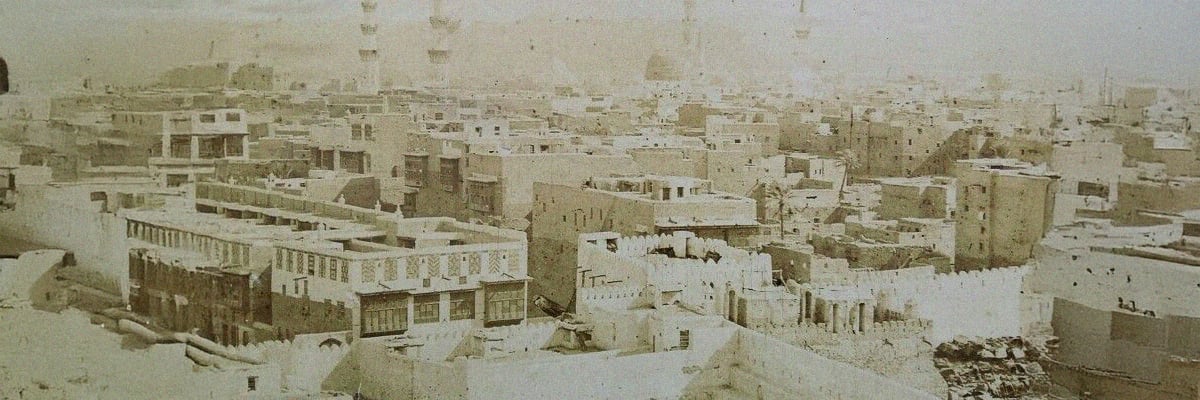

In the Prophet’s city of Madinah, many traders used to arrive. Among them were Jews, Christians, and fire-worshippers. After all, Madinah was a land of freedom for everyone.
On one such occasion, a Christian arrived from Syria. He had a small quantity of oil with him, clearly presenting himself as an oil seller. However, selling oil was only his side business. His main agenda was to propagate Christianity and to recruit people from Madinah to Syria. He secretly began his missionary activities in Madinah. Before long, he managed to attract two young men. They were the sons of a Sahabi (Companion of the Prophet) from among the Ansar. The father could not contain his sorrow. His wish was to forcibly bring them back into Islam. Since they were his own children, he believed it would not be difficult.
Seeking permission, he went to the Prophet (peace be upon him). With great distress, he explained his situation: “I am trying to forcibly bring my children back to our faith. Also, you should send some people to stop this man’s (the Christian’s) missionary activities.”
The Prophet (peace be upon him) disappointed him with a negative reply — not only refusing his request but also making the fundamental principle of Islam clear to him.
That principle was: “There is no compulsion in religion. Truth stands clearly distinct from falsehood.”
Quranic commentators testify that this verse of the Qur’an was revealed in connection with this very incident. This is a declaration that no other religion in the world can claim: There is no compulsion in religion. Only if a person truly believes in their heart can they be called a believer. The Qur’an has reiterated this principle in several places:
“There shall be no compulsion in religion. The right way has become distinct from error.” (Al-Baqarah 2:256)
“Proclaim: The truth is from your Lord. Whoever wills – let him believe; and whoever wills – let him disbelieve.” (Al-Kahf 18:29)
The Qur’an strongly forbids forcing anyone into Islam: “Had your Lord willed, all the people on earth would have believed. Will you then compel people to become believers?” (Yunus 10:99)
What more words are needed for those who seek to understand the nature of religious freedom within an Islamic society, civilization, and family? The Prophet (peace be upon him) was the leader and guide of a true faith movement. The messages from God were continuously conveyed to the people. In heart, speech, and deed, this was his sole preoccupation. How intense must have been the Prophet’s longing that everyone would become believers! The Qur’an unveils the intensity of this longing: “Perhaps you would kill yourself with grief because they do not believe.” (Al-Kahf 18:6) The Qur’an says that the Prophet (peace be upon him) might even harm himself out of grief when the disbelievers turned away from faith. Yet instead of encouraging efforts to forcibly bring them to belief, the Qur’an states: “If We willed, We could have sent down a sign to them from heaven, before which their necks would bend in submission.” (Ash-Shu’ara 26:3-4) Thus, the command is to propagate the truth — whoever wishes may embrace it. Even if no one accepts it, the propagation of truth must never cease. Preaching, or conveying the truth one believes, is the duty of every believer. Only the the scale and form of this duty may differ; coercion, however, has no place in this religion. Islam insists that preaching must never end in harassment or oppression. It must always be dignified.
The Qur’an says: “If they turn away, We have not sent you as a guardian over them. Your duty is only to convey (the message).” (Ash-Shura 42:48) “We know well whatever they say. You are not a tyrant over them. But admonish with the Qur’an says: “If they turn away, We have not sent you as a guardian over them. Your duty is only to convey (the message).” (Ash-Shura 42:48)“We know well whatever they say. You are not a tyrant over them. But admonish with “So remind! You are only a reminder. You are not over them a controller.” (Al- Ghashiyah 88:21–22)
In a Muslim nation or an Islamic society, no one is forcibly made a Muslim. No one is forced to say “Allahu Akbar” (God is Great) under compulsion. Islam has a clear, uncompromising stance on this, distinct from other religions. Islam defines the concept of faith (iman) with great clarity and precision. Even if a person recites the Qur’an a thousand times, declares a thousand times that God is One and Muhammad is His Messenger, prays for decades, and performs all religious rituals — if belief is not established in their heart, then that person is not a believer. Though others may call them a Muslim due to outward appearance, in truth, they are not Muslim. Such people are described by Islam as munafiqs (hypocrites). The Qur’an repeatedly warns that hypocrites will be in the lowest depths of Hell. This can be seen many times in the Prophet’s biography. For instance, look at the treaty made by the Prophet (peace be upon him) with the Christian priests of Najran. At the end of that detailed agreement, it reads:
“The Christians of Najran and their followers are under the protection and responsibility of Allah and His Prophet. Their lives, property, religion, land, clergy, and all under their possession, large or small, are protected. No change shall be made to their status. No hardship shall be brought upon their religious symbols, churches, or priests. No army shall tread their lands.”
This policy of the Prophet was renewed by the first Caliph, Abu Bakr al-Siddiq (may Allah be pleased with him), in exactly the same terms: “This is what Muhammad’s successor, Abu Bakr, has written for the people of Najran: They are under Allah’s protection and Muhammad’s protection. Their lives, property, religion, lands, followers, residents, religious symbols, churches, crosses, priests —everything is protected. They should not be insulted, troubled, or harmed in any way.” (Kitab al-Kharaj, p. 79)
The Prophet’s consistent policy is clearly seen in how he never forcibly converted even a single prisoner captured in battles. Historical records witness that more than six thousand prisoners were released according to their own will. It is for this reason that the famous orientalist historian, Sir Thomas Arnold, wrote in his celebrated work The Preaching of Islam: “Muhammad entered into treaties with several Arab Christian tribes, guaranteeing them protection and the freedom to practice their religion. Non-Muslim communities mostly enjoyed complete autonomy. They were allowed to manage their internal affairs and decide religious matters through their own priests. Their churches and monasteries remained untouched.”
The second Caliph, Umar ibn al-Khattab (may Allah be pleased with him), too, entered into treaties with Christian and Jewish priests. The treaty with the people of Aelia (Jerusalem) reads: “This is the protection letter given by the servant of Allah and leader of the believers, Umar, to the people of Aelia: Their lives, properties, churches, crosses, and all religious rituals are secured. Their churches shall not be demolished or altered. No harm shall come to their crosses or wealth. They shall not be forced to change their religion. None of them shall be harmed.” (Tarikh al-Tabari, vol. 3, p. 159)
Though Umar (may Allah be pleased with him) was known for his uncompromising zeal for justice, his compassion toward non-Muslims was born purely from the ideals of humanity and Islamic principles. One day, Umar (may Allah be pleased with him) was seated at the steps of a church. When it was time for prayer, he went outside and prayed alone on the church steps. He instructed his followers similarly. He then told the patriarch: “If I had prayed inside the church, there could be a claim in the future that the church belonged to Muslims!”
It was this same Umar (may Allah be pleased with him) who had a Christian slave named Istak. He tried to preach and guide him, but when it bore no fruit, Umar (may Allah be pleased with him) was content reciting the Qur’anic verse: “There is no compulsion in religion.” On another occasion, some Muslims seized a Jewish property and built a mosque upon It. When the complaint reached the Caliph, he immediately ordered the mosque to be demolished, and the land returned to the Jew. The famous Lebanese Christian scholar, Professor Kardahi, wrote in 1933: “The building known as Bayt al-Yahudi (House of the Jew) still exists today as a renowned structure.” (Reference: Khamāsar Tahil al-Islam fi al-Tarikh, p. 123) Thus, the position of Islam is beautifully clear: Let those who believe, believe; and those who disbelieve, disbelieve. Everything will be seen and judged in the Hereafter.