
The twenty-ninth chapter of the Qur’an bears the name al-ʿAnkabūt—“The Spider.” It receives this name from the forty-first verse of the chapter, where the spider is mentioned in a striking metaphor. That single verse holds such conceptual weight that it gives its name to the entire chapter. When the Qur’an names a creature explicitly, it invites us to contemplate it—not as a random mention, but as a sign with meaning. So let us delve into some foundational facts about the spider and how it features in this powerful Qur’anic analogy.
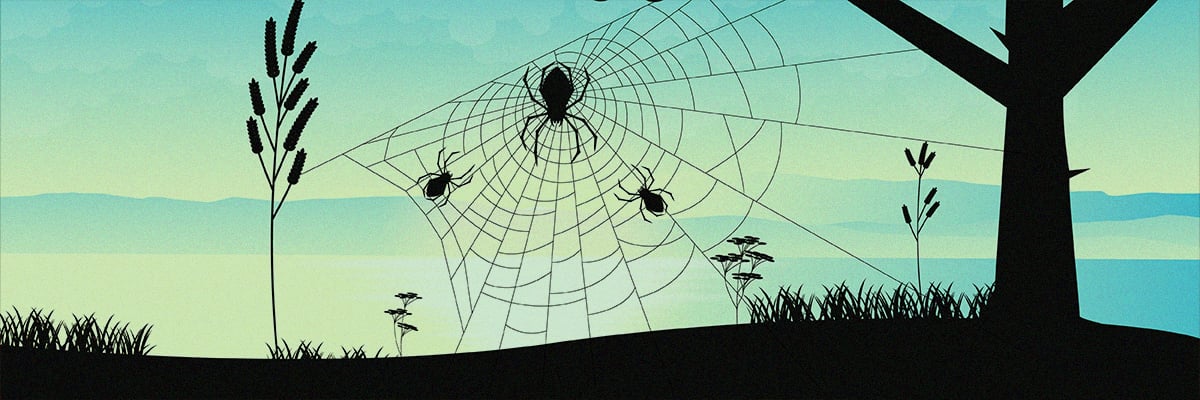
The spider, or ankabūt in Arabic, is a small invertebrate that spins its own web to trap prey. It belongs to the order Araneae in the class Arachnida. The scientific study of spiders is known as araneology. Around 44,540 species of spiders have been identified so far, spread across 3,924 genera and 112 families worldwide.
A spider’s body is divided into two main segments: the cephalothorax (a fusion of the head and thorax) and the abdomen. At its front are four pairs of legs, a pair of smaller appendages called pedipalps, and a set of fanged jaws known as chelicerae, which often include venom glands. The body narrows at the waist, separating the front segment from the back.
Spiders can have up to eight eyes—some species have six or four, and in rare cases, even two. They are carnivorous hunters, primarily feeding on other insects and arthropods. Covered with hair, their tough outer exoskeleton gives them protection. To reach maturity, spiders shed their skin multiple times, usually between seven and eight moults.
The Qur’anic Parable: Fragile Foundations of False Gods
In the Qur’an, the futility and meaninglessness of polytheism is illustrated with this powerful parable involving the spider:
{مَثَلُ ٱلَّذِینَ ٱتَّخَذُوا۟ مِن دُونِ ٱللَّهِ أَوۡلِیَاۤءَ كَمَثَلِ ٱلۡعَنكَبُوتِ ٱتَّخَذَتۡ بَیۡتࣰاۖ وَإِنَّ أَوۡهَنَ ٱلۡبُیُوتِ لَبَیۡتُ ٱلۡعَنكَبُوتِۚ لَوۡ كَانُوا۟ یَعۡلَمُونَ}
The example of those who take protectors other than Allah is like that of the spider who builds a house. And indeed, the frailest of all houses is the house of the spider—if only they knew! (Surah al-ʿAnkabūt, 29:41)
This parable is layered and intricate. Let us explore some of the wonders embedded within it.
1. The Central Idea
The chapter revolves around the futility of relying on false deities—how their foundations are hollow and their promises empty. This verse gives a general illustration of that theme, likening their condition to a spider building its web, imagining it to be a shelter. And so the spider becomes the conceptual nucleus of the chapter.
2. The Central Position
Not just in meaning, but even in placement, the spider occupies a central position. The first thirteen verses serve as an introduction; the final two (verses 68 and 69) form the conclusion. In between are 55 verses that constitute the main body of the chapter. It is precisely at the start of the second half that the verse about the spider appears—strategically and thematically central.
3. Solitary Existence
The word ʿankabūt is singular. Its plurals in Arabic include ʿankabūtāt, ʿanākib, and ʿanākīb. But here, the Qur’an uses the singular form deliberately. Why? Because spiders are typically solitary. Unlike bees or ants—who live in organized communities and rely on collective effort—the spider lives and builds alone. The bee and the ant appear in the Qur’an in chapters titled “An-Naḥl” (The Bee) and “An-Naml” (The Ant), both in plural, highlighting their collective nature. The spider, however, stands alone. The choice of the singular form is not accidental; it reflects the creature’s isolated existence.
4. Feminine Powe
The word ʿankabūt is grammatically used in both masculine and feminine forms in Arabic literature. For example, in the poetry of Abū Najm, one finds:
“mimmā yusdī al-ʿankabūt idh khalā”—using the masculine form.
But the Qur’an deliberately uses the feminine verb: اتَّخَذَتْ (“she took”). Why? Because in the world of spiders, it is typically the female that builds the web. Sometimes, the male may assist, but the act of construction is primarily hers. The Qur’an, as always, speaks with unmatched biological accuracy.
5. The Spider’s House, Not the Web
We commonly refer to a spider’s home as its web. But the Qur’an does not say “the web is weak”—instead, it says “the house is weak.” This distinction is important. The spider’s silk is, in fact, extraordinarily strong. Its threads are just one ten-thousandth of an inch thick—about 1/4000th the diameter of a human hair. Yet, gram for gram, spider silk is five times stronger than steel and three times stronger than Kevlar, the material used in bulletproof vests.
Studies show that some silk spun by orb-weaver spiders—especially from the Nephila genus—is even stronger than synthetic fibers. In fact, certain Canadian companies have started producing artificial spider silk to make surgical threads and fishing lines. Threads as thick as a finger, if made from spider silk, could theoretically hold even a jumbo jet.
The tensile strength of spider silk is estimated at around 1.3 GPa. So why, then, does the Qur’an say the house is weak?
Because strength is not just material. A house must serve its purpose—shelter from the heat and cold, protection from enemies, a space for safety and rest. In these functions, the spider’s house fails. Despite the physical strength of the threads, the structure is no shelter at all. Similarly, the idolaters of Makkah—despite their apparent might, their stone-carved homes like those of the Thamūd, their lofty towers like those of Pharaoh, and their economic clout like that of Quraysh—had no real refuge, no lasting victory. Their mighty structures and social systems were ultimately hollow, built on false beliefs.
6. A Home or a Killing Ground?
The word “house” (bayt) also has deep emotional and social connotations. A house is meant to be a place of comfort, rest, warmth, love, and protection. It is where mental fatigue eases, where burdens are shed, and where one finds peace with family, even if physical amenities are few.
But not so for the spider.
Its domestic life is tragic. After mating, some female spiders devour the male. Once the eggs hatch, the offspring may even consume their own mother. In many species, spiderlings engage in violent cannibalism immediately after birth, slaughtering one another in a frenzy. No father survives, no mother is spared, no sibling is safe. This is the condition of the spider’s house—a space of betrayal, carnage, and collapse. Can there be a house more fragile?
And so the Qur’an speaks with unparalleled precision. It is not just physical strength that matters, but the very function and meaning of a home—and the spider’s house fails on every front.
7. “If Only They Knew…”
The verse ends with a heartbreaking sigh: “if only they knew!”
Had they truly understood the parable, they would never have fallen into shirk—associating others with God. They would not have taken false gods as their allies and protectors. For such insight, knowledge alone is not enough—scientific reflection and deep awareness are needed. These signs are directed to those who reflect and observe.
As one studies the behavior of the bee or the spider, the layers of meaning in the Qur’an’s metaphors begin to unfold. And can anyone seriously suggest that these metaphors were the Prophet Muḥammad’s own invention? Or are they the words of the One who created all things, fashioned every creature, and governs the universe?
Indeed, these are the words of the Lord of the worlds.