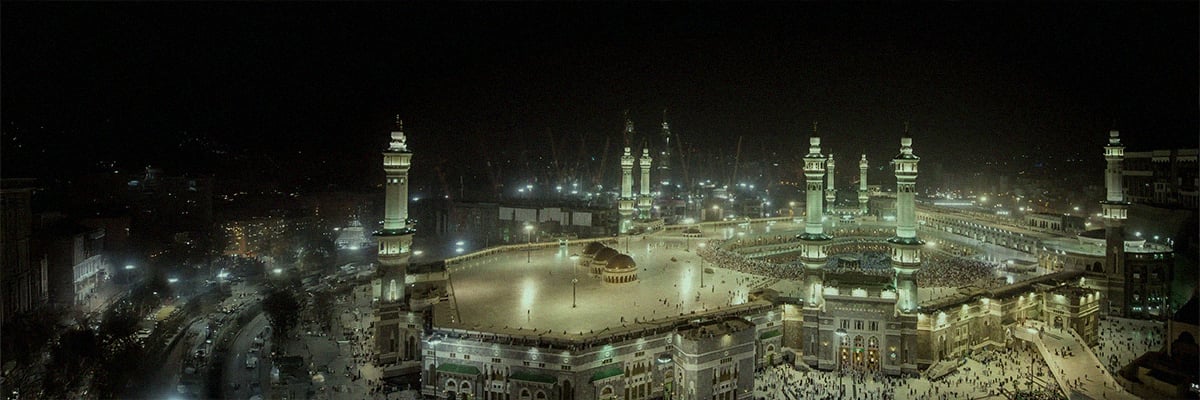

Those who entered into ihram for Umrah have now completed their Umrah and exited ihram. They may now either travel to Madinah or remain in Makkah.
Those who entered into ihram earlier for Hajj have performed the Tawaf of arrival (tawaf al-qudum) and the Sa’i, a component of Hajj, and are currently staying in Makkah while still in ihram.
Those arriving just before Hajj typically enter into ihram, perform the Tawaf of arrival, but do not perform the Sa’i at this stage, instead departing for Mina. The remaining rituals of Hajj commence now, starting from the 8th to the 13th of Dhul-Hijjah—six days during which the core acts of Hajj take place
At Mina…
On the 8th of Dhul-Hijjah, the pilgrim proceeds to Mina. This day is called Yawm al-Tarwiyah. The most important rite of Hajj—Arafah—is on the 9th of Dhul-Hijjah. Staying in Mina is a physical, mental, and spiritual preparation for this. The distance from Masjid al-Haram to Mina is walkable.
While in Mina, one should perform five prayers: Dhuhr, Asr, Maghrib, Isha of the 8th, and Fajr of the 9th. If possible, one should pray in Masjid al-Khayf near Jamrat al-Ula. The Prophet ﷺ performed these prayers there.
These moments in Mina should be spiritually enriched with acts of worship, while preparing for the next day’s journey to Arafah with both mental and physical readiness.
Standing in Arafah
The 9th of Dhul-Hijjah is the Day of Arafah. It is Sunnah to take a bath in the morning before departing for Arafah—this can be done in Mina itself.
Then one proceeds to Arafah, either by bus, metro train, or on foot. The distance from Mina to Arafah is about 18 kilometers. It is Sunnah to walk along the route the Prophet ﷺ took, known as Tariq al-Abtah.
Standing in Arafah (wuquf) is the most essential part of Hajj. It is a place where one must fully turn toward Allah with devotion and focus entirely on worship. The Prophet ﷺ said: “Hajj is Arafah”—meaning that the standing at Arafah is the central pillar of Hajj.
This is a place of descending divine mercy and forgiveness. Hence, one should actively seek it and repent. Every moment in Arafah is precious. One must engage in talbiyah, dhikr, salawat, and heartfelt prayers. Not a single moment should be wasted in idle talk or distraction.
The Prophet ﷺ stood in a particular location in Arafah, which men are encouraged to identify and stand near. That location is around Jabal al-Rahmah (Mount of Mercy). The best time during Arafah is the latter part of the day and the early part of the night. One must engage deeply in du’a during this time.
The official timeframe for wuquf in Arafah is from Dhuhr on the 9th until Fajr on the 10th of Dhul-Hijjah. Even if someone is within the boundaries of Arafah for a short while during this window, their wuquf is valid.
Arafah consists of Mount Rahmah and the vast surrounding plain. Today, its borders are clearly demarcated. Standing outside the official boundary of Arafah invalidates the wuquf. Missing the wuquf means the Hajj itself becomes invalid. While most missed rites of Hajj can be atoned for by sacrifice, wuquf at Arafah cannot be compensated.
Then to Muzdalifah…
After spiritually purifying the heart in Arafah, one must proceed to Muzdalifah. Departing Arafah should be accompanied by intensified dhikr and talbiyah. One must leave Arafah after sunset on the 9th. Muzdalifah lies between Arafah and Mina and is not far from Arafah.
One must be present in Muzdalifah even for a short while before dawn on the 10th of Dhul-Hijjah. Failing to do so requires dam (compensatory sacrifice). It is Sunnah to walk along the Prophet’s route, known as Ma’zamein, and to bathe before entering Muzdalifah if possible.
The night should be spent in dhikr and supplication. At one end of Muzdalifah lies Al-Mash’ar al-Haram, which is to be visited for prayer and supplication—it is a specific Sunnah.
From Muzdalifah, one should collect pebbles for the stoning of the Jamaraat on the 10th, 11th, 12th, and 13th of Dhul-Hijjah. A total of 70 pebbles are needed.
Back to Mina…
From Muzdalifah, with pebbles collected, one returns to Mina where the stoning (rami) of the Jamaraat takes place. There are three Jamaraat in total:
- Jamrat al-Ula
- Jamrat al-Wusta
- Jamrat al-Aqabah
On the 10th of Dhul-Hijjah (Eid day), only Jamrat al-Aqabah is to be stoned. No stones are to be thrown at the other two that day. Stoning may begin after midnight but the ideal time is from sunrise to just after noon. Until sunset of the 10th, the stoning is considered valid.
However, it is not obligatory to throw on the 10th itself—it can be done on the 11th, 12th, or 13th. But if delayed, one must first complete the 10th’s stoning before proceeding to the others.
Each of the seven pebbles must be thrown individually, saying takbir with each throw. Throwing them all at once is invalid.
If there is doubt whether a pebble landed in the designated spot, that particular stone must be thrown again.