
From the Meeqath, having donned Ihram, the journey is now directed toward Makkah.
Entering the sacred city of Makkah must be done with utmost humility, devotion, purity, and cleanliness. As part of this sanctity, taking a ritual bath (ghusl) before entering Makkah is a Sunnah. One must make the intention: “I am taking this bath in preparation for entering Makkah.”
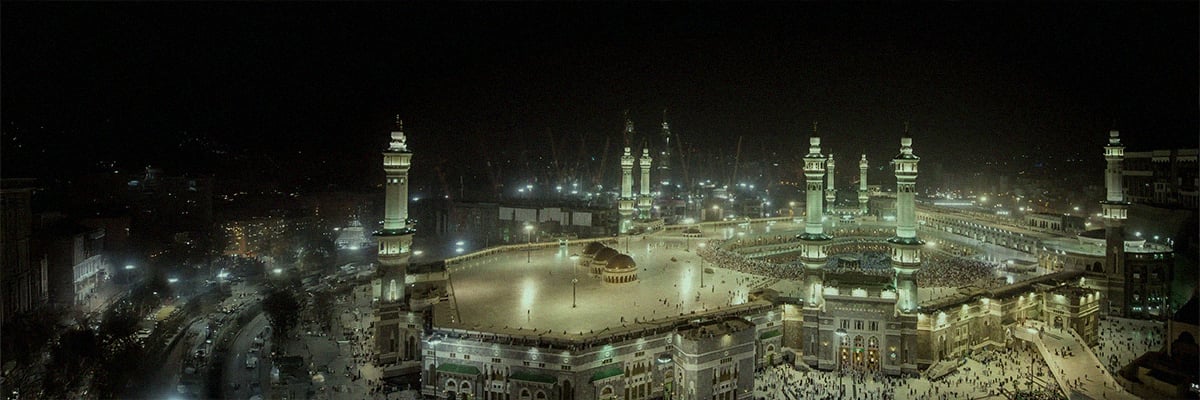
The most sacred mosque on earth is Masjid al-Haram. It houses the Kaaba Sharif. The Kaaba—the first house of worship on earth—was originally built by angels. Later, several prophets rebuilt it.
Inside the Kaaba is the Hajar al-Aswad, the black stone sent down from Paradise. With immense spiritual longing and the joy of finally seeing the Kaaba—towards which they have always turned in the five daily prayers—believers walk through Masjid al-Haram for their first sight of the Kaaba. It is an overwhelmingly emotional moment. Tears flow from eyes out of sheer joy!
The moment one first sees the Kaaba is a highly recommended time to make duʿa (supplication), as it is likely to be answered. One should ask Allah for both worldly and otherworldly needs at that time.
The Arrival Circumambulation (Tawaf al-Qudum)
Upon reaching Makkah, the first act of worship is the circumambulation (Tawaf) of the Kaaba. Regardless of whether one is in Ihram for Hajj or not, one must perform this upon entering Masjid al-Haram. This is not one of the obligatory components of Hajj, but a ritual act of greeting the Kaaba.
However, for those who have entered into Ihram for ʿUmrah, the first Tawaf they perform is the obligatory ʿUmrah Tawaf, which automatically includes the arrival Tawaf. Therefore, they don’t need to repeat the Tawaf al-Qudum afterward.
Important Rules During Tawaf:
1) Intention (Niyyah):
It is obligatory to make a niyyah only when performing a Tawaf not part of Hajj or ʿUmrah. However, even when it is part of Hajj or ʿUmrah, making an intention is still Sunnah.
2) Covering One’s Nakedness (ʿAwrah):
Just as in prayer, the parts of the body that must be covered must also be covered during Tawaf.
- For men: the area from the navel to the knees.
- For women: all except the face and hands.
3) Purity from Physical Impurities:
The body and clothes must be clean. One must also be in a state of ritual purity (wudu).
- If purity is lost during Tawaf, one must stop, purify oneself, and then complete the remaining rounds.
- Avoid touching non-related individuals, as skin contact can nullify wudu. Be especially cautious of this.
4) How Tawaf is to be Performed:
- One must circle the Kaaba seven times with it always on the left side. Only then is it considered a valid Tawaf.
- The Tawaf must begin from the Hajar al-Aswad; if started elsewhere, the Tawaf is only counted from the point of reaching the Hajar al-Aswad.
- The body of the pilgrim must remain outside the Kaaba’s structure entirely.
- The semicircular wall (Hijr Ismail) is considered part of the Kaaba. Circumambulating through it renders the Tawaf invalid.
- The intention must be solely for Tawaf and not for finding friends or other purposes—such Tawaf is not valid.
All the above rules are mandatory for a valid Tawaf. Without adhering to them, the act is not accepted.
Recommended Acts in Tawaf:
1) Walking Barefoot: Performing Tawaf barefoot is recommended (mustahabb).
2) Making Intention: If the Tawaf is part of Hajj or ʿUmrah, intention is Sunnah but not obligatory.
3) Uncovering the Right Shoulder (Men Only)
- During Ihram, men should pass the middle of the upper garment under the right arm and place both ends over the left shoulder, keeping the right shoulder exposed.
- This is Sunnah only during the Tawaf before the Saʿy (walking between Safa and Marwa).
4) Kissing the Hajar al-Aswad
- At the start of each round, kiss the Hajar al-Aswad and place one’s forehead on it, if possible.
5) Walking Briskly with Shoulders Shaking (Raml)
- During the first three circuits of obligatory or arrival Tawaf, men should walk briskly with short steps and shake their shoulders.
- The remaining four rounds should be walked normally.
6) Continuity Without Interruption
- Tawaf should be completed without breaks in between.
7) Perform with Devotion and Supplication
- Walk with full devotion, making supplications during each round.
8) After Tawaf
- Perform two units (rakʿahs) of prayer.Then drink from the Zamzam water.