
Islam is not merely a religion encompassing a few ritualistic ceremonies; rather, it is a comprehensive way of life. Just as it provides clear perspectives on worship, it also lays down clear directives in economic matters and beyond.
The earth and all its resources have been created by the Creator for humankind. However, God has not distributed His blessings equally among people. This disparity is evident not just in beauty, health, and intellect, but also in wealth.
Ultimately, God is the real owner of wealth. Humans are only temporary custodians. From this foundational principle, believers realize that zakat is not the generosity of the wealthy but the right of the poor. Instead of wealth accumulating in the hands of a few, zakat enables its flow towards the needy.
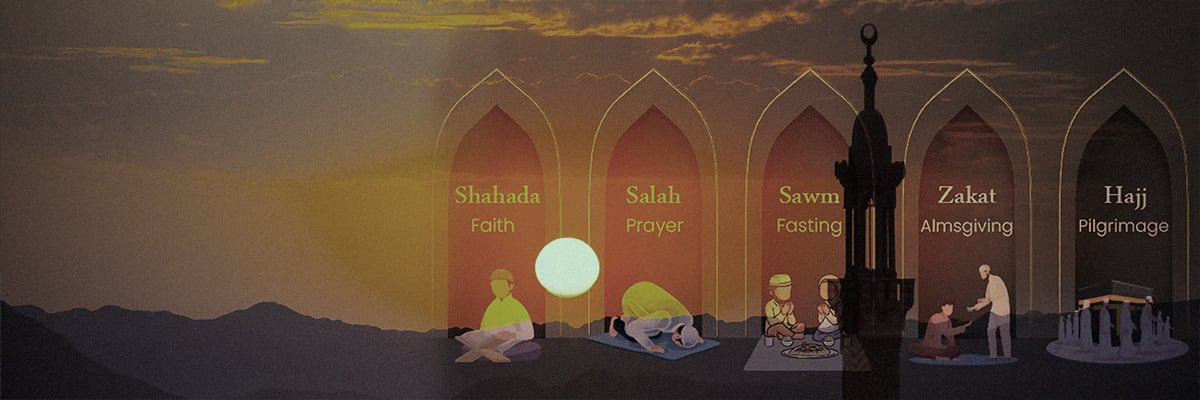
Islam mandates that those blessed with more wealth must allocate a fixed share of their wealth to the underprivileged. This obligation is termed as zakat. It is one of the five pillars of Islam. In over eighty places in the Holy Qur’an where prayer is mentioned, zakat is also referred to alongside it. Technically, zakat refers to the wealth that the rich are obliged to give to the rightful claimants, based on a fixed percentage of their wealth.
Just as a flowing river remains pure, zakat purifies wealth and the giver. It strengthens devotion and faith in the heart of the wealth owner. That is why the term zakat, meaning purification, is used.
Zakat is obligatory on gold, silver, currency, trade goods, grains, dates, grapes, goats, cows, and camels. Any Muslim who owns these in specified quantities must compulsorily give zakat.
History reminds us that the system of zakat is sufficient to eradicate poverty and to enable every individual to attain economic prosperity. The prime example is during the reign of Umar (RA), the second ruler of the Islamic republic, when the Muslim community in Yemen had achieved such economic stability that there were no claimants left to receive zakat.
Religious obligation is only fulfilled when zakat reaches its rightful recipients. If zakat does not reach them, the donor is deemed culpable. Zakat should be distributed within the locality where it is collected. Only if there are no rightful recipients locally may it be transferred to a neighboring area.
The recipients of zakat include the extremely poor, the poor, those burdened with debts, travelers, and new converts to Islam. At least three individuals must be selected from each category for distribution, and the amount should be divided equally among the categories. However, within each category, differences can be made based on individual needs. For instance, if a town has the extremely poor, poor, debt-ridden, and new converts, and the available zakat is ₹100,000, then ₹25,000 should be allocated to each category. If there are only three debt-ridden individuals, the amount can be distributed unequally among them according to their needs.
Today, zakat obligations also extend to receivable debts, chit funds, provident funds, and various deposits. Properly reaching rightful recipients ensures effective poverty eradication.
Now, let us familiarize ourselves with zakat on different categories:
Zakat on Trade
Trade is one of the most important means adopted by humans to earn wealth. Islam strongly encourages trade. The Prophet ﷺ and his companions also engaged in trade activities. However, Islam only permits trade that is based on honesty and truthfulness without any deceit.
Since trade is an area prone to cheating and deception, Islam promises great rewards to traders who uphold honesty and integrity. A trader should ensure that through his trade, he attains success both in this world and the Hereafter. Besides earning a livelihood for himself and his dependents, he should prepare for his life after death through his trade.
If the conditions are met, zakat becomes obligatory on trade goods. From the time a person starts a business, once a lunar year completes, he must calculate the current trade stock and unspent profits at market value. If the combined value equals or exceeds the value of 595 grams of silver, then he must give 2.5% of it as zakat.
There is no zakat on the stock during the year; it is calculated only on the goods available at the completion of the year. Zakat must be distributed in the place where the trade is conducted. For trade-related zakat, money equivalent to the zakat amount should be given.
An Example:
Suppose a merchant named Midlaj bought goods for opening a furniture shop in Kozhikode city on the 1st of Muharram, the first month of the lunar calendar. The shop was inaugurated on the 20th of Muharram and grew into a well-functioning business. The profits were deposited in a bank. Now it is the 30th of Dhul-Hijjah, the last day of the Islamic year, and a full lunar year has completed since the start of the business.
Upon stocktaking, the value of saleable furniture in the shop, according to the wholesale market rate of Kozhikode, is ₹2,000,000 (2 million rupees). (Furniture and electrical items not meant for sale are not counted.) The unspent profit deposited in the bank amounts to ₹3,000,000.
Thus, the total amount at the end of the year is ₹5,000,000. The value of 595 grams of silver according to the current market is ₹40,000.
Since the total wealth exceeds the zakat threshold, Midlaj must pay zakat at 2.5% of ₹5,000,000, which amounts to ₹125,000.
This amount must be distributed among the rightful recipients in Kozhikode city, and Midlaj no longer retains ownership over that amount.
Zakat on Gold and Silver
The Qur’an severely criticizes those who hoard gold and silver without giving zakat. The Prophet ﷺ warned that such gold and silver will be turned into heated plates and used to brand the foreheads, sides, and backs of their owners on the Day of Judgment.
Anyone who possesses gold, silver, or equivalent currencies for a complete lunar year must give 2.5% of their value as zakat.
The minimum threshold for zakat on silver is 595 grams and for gold, 85 grams (approximately 10.5 sovereigns).
If one holds this amount or more for a full year, zakat is obligatory. However, personal jewelry used regularly does not require zakat. Only gold or silver held for savings or investment purposes is subject to zakat.
An Example:
If a sister named Fatima bought 20 sovereigns of gold as coins for safekeeping on Muharram 1st, then after one lunar year on the next Muharram 1st, she must give zakat equivalent to 2.5% of 20 sovereigns (i.e., zakat for half a sovereign).
If gold or silver is accumulated gradually and reaches the zakat threshold, zakat must be paid after completing one year from the point when the threshold was first reached.
For example, if one sovereign is saved in January 2020, and gold is added every month, reaching 11 sovereigns by November 2020, then zakat is not due in January 2021, because the minimum zakat amount was not held for one year yet. Instead, zakat would be due in November 2021.
(Note: This example uses the Gregorian calendar for clarity, but zakat must be calculated according to the Islamic lunar calendar.)
Zakat on Currency
If a person holds currency equivalent in value to the zakat threshold (the value of 595 grams of silver) for a full lunar year, he must pay zakat at 2.5%.
Receivable debts, provident funds, deposits, and chit funds, being amounts due to the person, also require zakat. If payment is difficult at present, zakat can be given when the amount is received. However, all due zakat must be calculated and paid cumulatively.
An Example:
Suppose on the 10th of Muharram, Anas lent ₹50,000 to a friend. On the 10th of the next Muharram, if the market value of 595 grams of silver is less than ₹50,000, Anas must pay 2.5% zakat on ₹50,000 (i.e., ₹1,250).
If later he realizes the debt is unrecoverable, zakat needs to be paid only if and when the amount is recovered.
Just like debts, zakat is also obligatory on amounts recovered from theft or confiscation once reclaimed.
Provident funds, where a fixed amount is deducted from an employee’s salary and returned upon retirement or other conditions, also require zakat after one year if the amount meets the zakat threshold.
An Example:
Suppose ₹1,000 is deducted monthly and after three years, the provident fund amounts to ₹36,000. If the market value of 595 grams of silver equals ₹36,000, then after completing a year, zakat at 2.5% must be paid on that amount, and then yearly on any additional accumulations.
However, bonuses not yet received are not subject to zakat. Only once bonuses are received, if they are kept for a year and meet the zakat threshold, zakat becomes obligatory.
Zakat on Agricultural Produce
Zakat is obligatory on certain crops and fruits produced by human effort — primarily food grains and fruits that can be stored, such as wheat, paddy, barley, corn, millet, sesame, lentils, chickpeas, raisins, and dates.
Zakat becomes obligatory only when these crops reach a specified quantity and ripen to maturity.
For grains (after removing husks and stalks and drying) the minimum threshold is 960 liters. For grains stored in husks like paddy, the threshold is 1920 liters.
Zakat should be given after cleaning and drying the produce, not on the raw harvest.
It is not necessary that the entire amount be harvested at once to impose zakat. Even if the harvests occur multiple times in a year, the produce should be combined. If the total meets or exceeds the zakat threshold, zakat must be paid.
Example:
Suppose the first harvest is in Muharram and yields 500 liters of wheat. Since this does not meet the zakat threshold, no zakat is due yet. However, if six months later, another harvest yields 500 liters, the total becomes 1000 liters, exceeding the threshold, thus making zakat obligatory.
But produce from one lunar year cannot be combined with the next year’s produce for zakat calculation. Also, different types like dates and grapes, or wheat and barley, cannot be combined.
If the crops grew purely with rainwater or without human irrigation, 10% of the harvest must be given as zakat.
If human labor and irrigation costs were involved, 5% must be given.
If a portion was irrigated naturally and another with human effort, the zakat for each should be calculated separately based on its respective percentage.
Zakat on Livestock
Zakat on livestock applies only to camels, cows, and goats. The conditions for zakat on livestock are:
- A minimum number must be owned.
- They must be under ownership for the entire lunar year.
- They must graze naturally throughout the year without being fed.
- They must not be primarily used for labor such as plowing or carrying loads.
Livestock used for work or fed by buying food is not subject to zakat.
Below are the obligatory numbers and what must be given:
Camels
- 1–4 camels: No zakat
- 5–9 camels: One goat (either a two-year-old male goat or a one-year-old female goat)
- 10–14 camels: Two goats
- 15–19 camels: Three goats
- 20–24 camels: Four goats
- 25–35 camels: One two-year-old female camel
- 36–45 camels: One three-year-old female camel
- 46–60 camels: One four-year-old female camel
- 61–75 camels: One four-year-old female camel
- 76–90 camels: Two three-year-old female camels
- 91–120 camels: Two four-year-old female camels
- 121 camels onwards:
- For every 40 camels: one two-year-old female camel
- For every 50 camels: one three-year-old female camel
(Example: For 160 camels: four two-year-old camels)
Cows
- 1–29 cows: No zakat
- 30–39 cows: One one-year-old calf
- 40–59 cows: One two-year-old calf
- 60 cows: Two one-year-old calves
- Beyond 60:
- For every 30 cows: one one-year-old calf
- For every 40 cows: one two-year-old calf
(Example: For 90 cows: three one-year-old calves; for 80 cows: two two-year-old calves)
Goats
- 1–39 goats: No zakat
- 40–120 goats: One goat (same age criteria)
- 121–200 goats: Two goats
- 201–300 goats: Three goats
- 301 goats onwards: One goat for every hundred goats
(Example: 500 goats → five goats to be given)
If livestock breeds and produces offspring during the year, the newborns are included for zakat without needing to complete a year individually.
Zakat on Mining (Extracted Wealth)
If gold or silver is extracted from land that is either privately owned or ownerless, zakat becomes obligatory immediately without waiting for a year. 2.5% (one-fortieth) must be paid as zakat on the purified amount after removing impurities like dirt and stones.
Mining must be a continuous activity. However, if mining was interrupted for legitimate reasons (like repairs or war) and resumed, the quantities extracted before and after should be combined.
If the extracted quantity meets the minimum zakat threshold (10.5 sovereigns for gold or 595 grams for silver), zakat becomes obligatory.
Zakat on Buried Treasure (Rikaz)
Buried treasure that is found and falls under zakat-applicable amounts must immediately be given 20% (one-fifth) as zakat. If it is found on another person’s property, it belongs to the owner, and they must give zakat.
If the owner is unknown, the finder must search for the rightful owner for up to a year. If no one is found after public announcements, the treasure can be owned by the finder.
Fitr Zakat (Zakat al-Fitr)
Ramadan, the ninth month of the Islamic lunar calendar, is the most blessed month, a time of fasting and self-purification for believers. Eid al-Fitr, the festival marking the end of Ramadan, occurs on the first day of Shawwal, the next lunar month.
The charity given specifically on the day of Eid, before the Eid prayer, is called Fitr Zakat or Zakat al-Fitr. While other forms of zakat are linked to wealth, Fitr Zakat is linked to individuals.
According to Islamic law, it is the responsibility of the head of the family to pay Fitr Zakat on behalf of himself, his wife, children, and dependent elderly parents.
Fitr Zakat serves two purposes:
- It compensates for any shortcomings in the fasting of Ramadan.
- It ensures that even the poor can celebrate Eid joyfully.
There is no condition of a one-year possession or wealth threshold for Fitr Zakat. Anyone who has sufficient means to meet their Eid expenses must pay Fitr Zakat for themselves and those under their financial responsibility. Thus, sometimes even the poor are required to give Fitr Zakat.
It must be given from the staple food of the land. Giving its equivalent value in money does not suffice unless there is no alternative.
Fitr Zakat must be distributed after the sighting of the Shawwal moon but before the Eid prayer. It is permissible to distribute it up until sunset on the day of Eid. Delaying beyond sunset is sinful.
Each individual must give 3 liters and 200 milliliters (approximately 2.6 kilograms) of staple food.
Example: If a household consists of husband, wife, and four children, the head of the family must give Fitr Zakat amounting to 19.2 liters (around 15.6 kilograms of food) in total.
Like other acts of worship, the intention (niyyah) must be made to fulfill the obligation of Fitr Zakat. The zakat must be given in the location where the person is at the time of Eid.
Example:
If a person is in a Gulf country at sunset on the last day of Ramadan, they must pay Fitr Zakat there itself, not in their home country.
Fitr Zakat becomes obligatory on anyone alive during the final moments of Ramadan and the beginning of Shawwal.
Thus, if a child is born just before Eid or a person dies just after sunset on Eid night, Fitr Zakat is still obligatory on them.
If a child is born after sunset, or a person dies before sunset, Fitr Zakat is not obligatory for them.