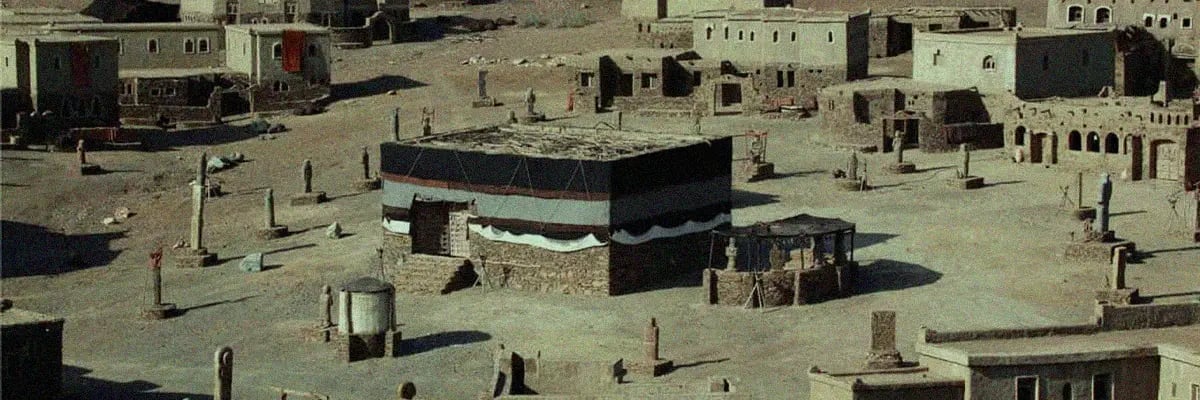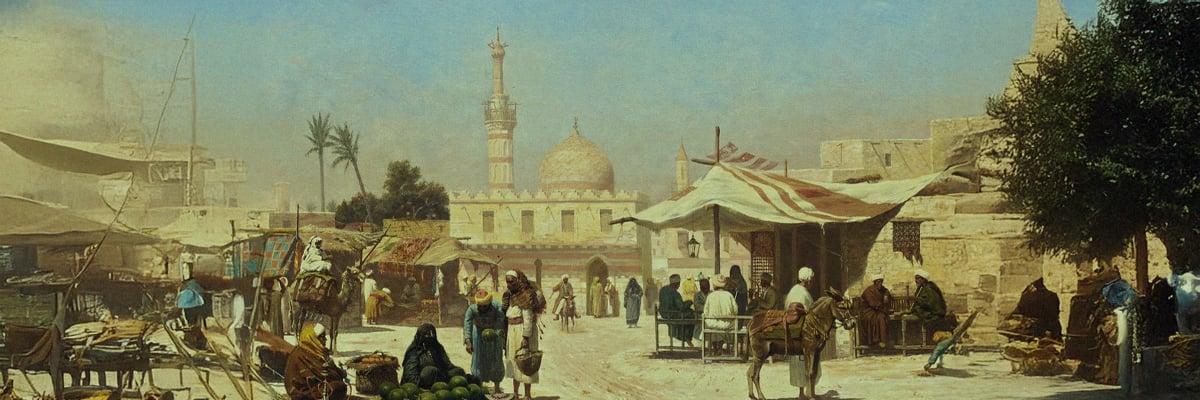
Umar walked the quiet streets of Makkah, his heart unsettled, a familiar thirst gnawing at him. Tonight, he wanted the comfort of wine, a chance to lose himself in the easy laughter and camaraderie of friends. But when he reached their usual gathering place, silence greeted him—the room was empty, the cups dry.
Frustrated, he turned on his heel, deciding to visit Makkah’s finest brewer. Surely, he’d find relief there. He cut through narrow alleys, his footsteps quickening with the need to quench his longing. Yet, once more, disappointment waited: the brewer’s door was firmly shut.
Alone in the moonlit street, he clenched his fists, the stillness around him sharp and pressing. A new thought flickered to life in the back of his mind, unexpected and intense a thought that began to fill the emptiness around him, an urgency he couldn’t shake:
“Muhammad.”
The name lingered, prickling his mind like a thorn. “This man claims to be a Prophet. He wants us to abandon our ancestors’ gods. Who does he think he is?” A fire sparked in Umar’s chest. “This has to stop. If no one else will act, I will.”
Gripping the hilt of his sword, Umar set his jaw and made his decision: he would kill Muhammad.
Without hesitation, Umar began marching toward his target. The city’s dim streets seemed to narrow around him as he focused, his gaze darkened with determination. Sword in hand, he was prepared to do whatever it took.
But then, as Umar turned down another street, he ran into Nu’aym ibn Abdullah. Nu’aym was an old acquaintance, but unknown to Umar, he was also a secret Muslim. He had embraced the message of Muhammad ﷺ quietly, fearful of the consequences if his allegiance were known. Tonight, however, as he caught sight of Umar’s determined stride and the glint in his eyes, Nu’aym sensed trouble.
"Where are you headed, Umar?" Nu’aym asked, trying to keep his tone casual, though his heart beat faster.
“I’m going to kill Muhammad”
Umar replied, voice steely and resolute, his hand resting on the hilt of his sword.
Nu’aym’s eyes widened, his mind racing. He needed to stall Umar, to deflect him somehow without betraying his fellow Muslims. So he put on a look of cautious concern and leaned in closer.
“You think Banu Abd Manaf will just let you strike Muhammad and walk away?” Nu’aym asked, his voice low but tense.
Umar’s eyes narrowed, suspicion flickering across his face. “Have you, too, abandoned our gods?”
Nu’aym paused, carefully choosing his words. He saw an opportunity to steer Umar’s rage elsewhere, away from immediate bloodshed. “Before you go looking for Muhammad, maybe you should turn your eyes closer to home,” he said quietly. “Have you heard about your sister Fatimah and her husband, Sa’eed? They’ve already embraced Muhammd’s message.”
Umar froze, the words sinking in. His anger flared, now redirected toward an even closer target. Without another word, he stormed off toward his sister’s home, each step fueled by an even more intense fury. And behind him, Nu’aym let out a silent breath of relief. Perhaps this detour would give others the time they needed to protect the Prophet ﷺ, and maybe, just maybe, open Umar’s heart in a way he hadn’t expected.
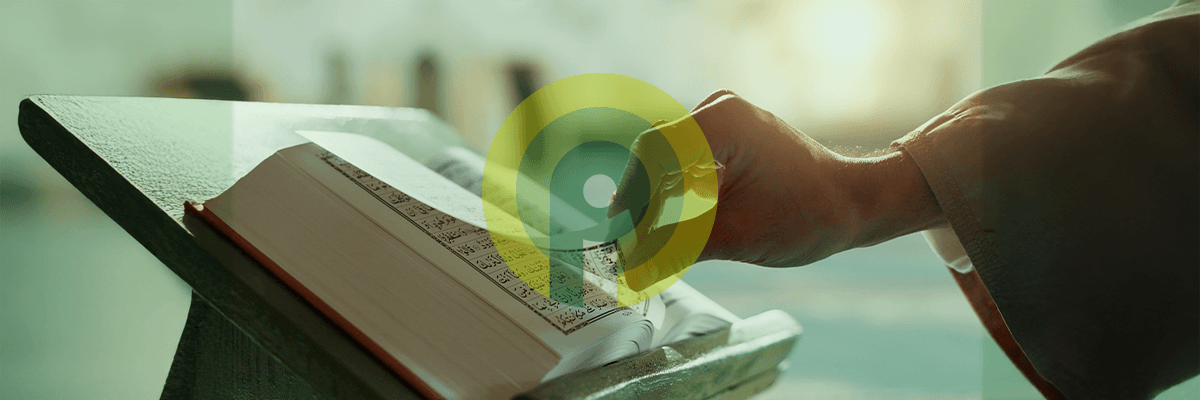
As Umar approached Fatimah’s home, he heard the soft recitation of verses, their rhythm filling the air with an otherworldly calm. But his anger was all-consuming. He burst into the room, startling Fatimah and Sa’eed, who quickly tried to hide the page they’d been reading.
“What was that sound I heard?” he demanded, his voice like thunder.
“It was nothing, Umar,” Fatimah replied, her eyes avoiding his.
“You’ve turned to Muhammad’s beliefs!” he snarled, raising his hand and striking Sa’eed. Fatimah stepped between them, trying to shield her husband, but Umar’s heavy hand came down on her instead, sending her reeling, blood trickling down her face.
The sight of her blood stopped Umar cold. His chest heaved as he looked into her defiant gaze. Fatimah, undeterred, met his eyes and spoke calmly but firmly:
“Yes, Umar, we have believed,” she said, her voice steady. “Do what you will, but we won’t turn back.”
Umar’s fury softened, unsettled by a strange curiosity. His gaze shifted from her blood-streaked face to the page she clutched. He wrestled with himself, his anger yielding to a craving he couldn’t ignore.
“Show me what you were reading,” he said, the demand softened into a request.
As one of Makkah’s most respected men, Umar was well-versed in the rhetoric of Jahiliyya poetry. Every year, he served as a judge at the poetry competitions held in the Ukkaz Market. He was in every sense a connoisseur of fine language and eloquence. Yet the words he had overheard today, just fragments of the Qur'an, struck him with a force he had never known. They were unlike anything he had ever heard, different from the finest poetry or prose of his people.
In these early days, many Quraysh had been drawn to the Prophet’s words, sneaking through the quiet streets of Makkah at night to eavesdrop on the Qur’an being recited from behind Muslim homes. Despite their stubborn opposition, they craved to hear more, captivated and unsettled by a beauty and power they couldn’t ignore.
Umar’s craving now mirrored theirs. He longed to understand what could evoke such loyalty and love among his own kin, the very thing that had challenged everything he knew. As he looked at the page, his anger dissolved, replaced by a hunger he had never felt before.
Fatimah, her voice calm but firm, replied, “First, you must purify yourself, Umar. This is a sacred text, and only the pure may touch it.”
Umar paused, a flicker of respect cutting through his agitation. Then, without a word, he went to cleanse himself. When he returned, Fatimah handed him the page, and his gaze fell upon the verses of Surah Taha.
Each line seemed to reach into him, calling out to a part of himself he hadn’t known existed. The words were majestic, beautiful, unlike any poetry he’d judged at the famed Ukkaz Market. The rhythm, the power, the depth—they were beyond anything he’d encountered, surpassing the finest expressions of his people. They spoke to him, piercing through layers of anger and pride, igniting something within.
As Umar read, a figure emerged quietly from the shadows—it was Khabbab, a believer who had been hiding. During those early days of Islam, the small group of secret Muslims would gather discreetly to learn and recite the Qur’an, their meetings concealed from the Quraysh who were hostile to their faith. Khabbab had been visiting to share the teachings of the Qur’an with Fatimah and Sa’eed, but when Umar’s heavy knock sounded on the door, he instinctively hid, fearing for their safety. Now, seeing Umar’s softened demeanor, he stepped forward, his eyes alight with conviction.
“Umar,” he said quietly, “Last night, I heard the Prophet ﷺ pray, ‘O Allah, strengthen Islam with one of the two Umars—Umar ibn al-Khattab or Abu Jahl.’’
In those words, Umar sensed the gravity of his own actions, his potential to transform from one of Islam’s fiercest opponents to one of its most powerful defenders. He was overwhelmed, realizing he stood at a crossroads, perhaps chosen by the Prophet ﷺ himself for a greater purpose.
The weight of these words fell upon Umar like a spark igniting within him. He realized that even as he had railed against the message, the Prophet ﷺ had prayed for his transformation—not with resentment, but with hope. His heart pounded as he felt a pull he could no longer resist. The storm within him had found its path; now, Umar’s journey was clear. He turned to Khabbab, and with newfound urgency, asked, "Where is Muhammad now?"
Khabbab told him, and without another word, Umar left, his stride resolute, heading for Dar Al-Arqam where the Prophet ﷺ was with his companions.
When he reached the door, he knocked firmly. Inside, the companions fell silent, recognizing his voice. Hamza, never one to shy away from a fight, reached for his sword, his gaze steady. “If he comes with peace, we welcome him. If not, my sword will settle this.”
The Prophet ﷺ, sensing the tension, spoke with calm assurance, “Let him in.”
As Umar entered, his gaze locked onto the Prophet’s ﷺ. His heart, which had been a storm only hours before, was now quiet, softened by a force he couldn’t yet name. Standing there, something in him surrendered, and in a voice that trembled with a newfound certainty, he declared, “I bear witness that there is no god but Allah, and that Muhammad is His Messenger.”
The Prophet ﷺ, his face radiant, cried out, “Allahu Akbar!” The companions echoed it, their voices filling the room with joy and awe. In that instant, Umar felt a weight lift—a burden he hadn’t even known he was carrying. The man who had set out with a sword to kill had now found himself reborn, pledging that sword to protect the very man he once opposed.
And thus, a new chapter began—one in which Umar would become one of Islam’s strongest defenders, a warrior whose heart now beat for truth and justice.