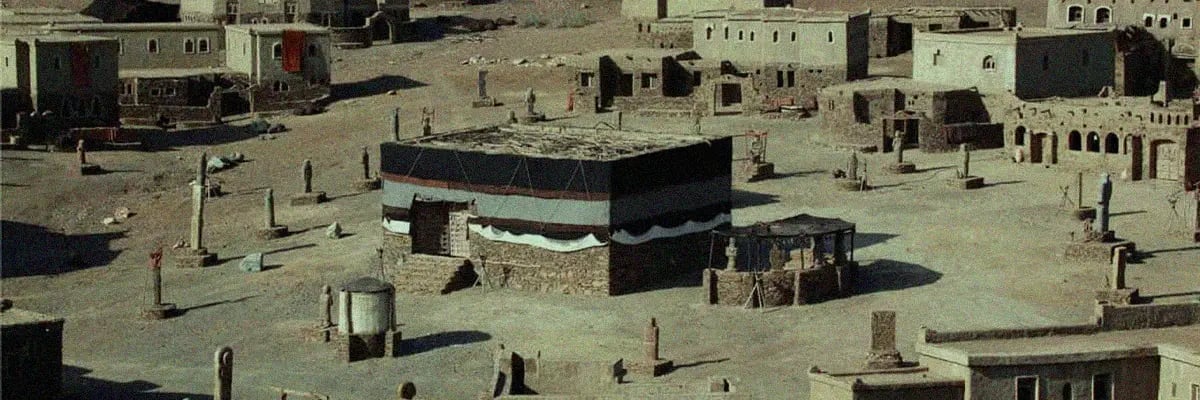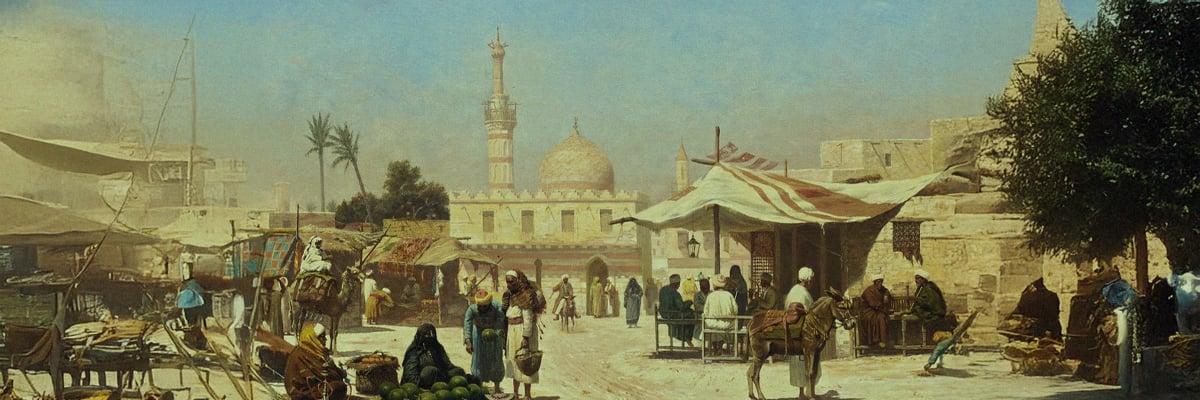

The bustling marketplace of Makkah buzzed with activity. Traders haggled, customers browsed, and the air was thick with the scents of spices and the murmurs of countless voices. Amid this commotion, a voice rang out, cutting through the noise like a blade:
"Has anyone here heard of a child born last night?"
The crowd paused, curious and bewildered. The question had come from a Jewish merchant, a man known for his deep knowledge of ancient scriptures. His voice, insistent and clear, demanded attention as he repeated the question:
"Did anyone in your tribe have a child last night?"
Confused glances were exchanged. “We don’t know,” came the hesitant reply. But the merchant was not to be deterred. He declared with conviction, “Listen carefully, Quraysh! Last night, a prophet was born—a leader for this nation. His name is Ahmad, and between his shoulders is the seal of prophethood.”
The crowd was intrigued. They went back to their homes, discussing the unusual proclamation. In one household, someone mentioned that Abdullah’s wife, Amina, had given birth to a son, Muhammad.
“Could it be him?” they wondered aloud.
Curiosity overtook them, and they brought the merchant to Amina’s home. There, they showed him the child. As the merchant gazed upon the infant and the seal of prophethood on his back, he fainted. When he regained consciousness, his face bore an expression of both awe and despair.
“What happened to you?” they asked.
His voice was heavy as he replied, “The mantle of prophethood has been taken from the Children of Israel and passed to the Arabs. Rejoice, Quraysh! For you now carry the banner of divine guidance.”
This event was not an isolated occurrence. For centuries, the Jewish and Christian scholars had been awaiting the arrival of a prophet whose description was etched in their holy texts. His name, lineage, and even his physical features had been foretold. Some even named their children Muhammad in the hope that they might embody the prophesied figure.
A NAME WRITTEN IN THE HEAVENS
Khalifah ibn Abdi recalls asking Muhammad ibn Ajid about the origin of his name. His father had taken him to meet a learned Christian monk in Syria. This monk, a figure of great knowledge, had declared, “A prophet is to emerge soon among the Arabs. He will be the last prophet, and his name will be Muhammad. Follow him, and you will succeed.”
Upon returning home, inspired by the monk’s words, the father named his son Muhammad. Such stories are not mere folklore but are woven into the fabric of historical memory, repeated across generations as testimonies of the awaited one.
IMAGES OF PROPHECY
Perhaps one of the most striking accounts comes from Jubayr ibn Mut’im, who traveled to Syria during the early days of the Prophet Muhammad’s ﷺ mission. There, he encountered Christian priests who took him to a monastery filled with murals and images.
“Do you recognize anyone here?” they asked him, gesturing to the walls adorned with depictions of various prophets.
He scanned the images and, to his astonishment, saw a face he recognized: the face of Muhammad ﷺ. Standing beside him was another familiar figure—Abu Bakr, his closest companion.
“Is this the man?” they pressed.
“Yes,” Jubayr replied. “That is him.”
The priests nodded solemnly, confirming their knowledge of the Prophet’s coming, a knowledge rooted in scriptures passed down through their traditions.
GUIDED BY PROPHECIES
The journey to truth was not always smooth. Take the example of Amr ibn Absah. Dissatisfied with his tribe’s idolatry, he sought guidance from a Jewish scholar. The scholar told him this: “A prophet will arise in Makkah. He will call people to the worship of one God. Seek him out.”
Year after year, Amr visited Makkah, asking travelers if any news of a prophet had emerged. Finally, his persistence bore fruit. Upon hearing of Muhammad ﷺ, he raced to Makkah, met him, and immediately accepted Islam.
The anticipation for the Prophet’s arrival was palpable, even among those outside Arabia. His coming was foretold not only in spiritual circles but also in the geopolitical shifts of the time. His life was a culmination of divine preparation, a fulfillment of centuries of prophecies.
A LIGHT FORETOLD IN SCRIPTURES
The Quran itself bears witness to these prophecies:
“Those who follow the Messenger, the unlettered prophet, whom they find written in what they have of the Torah and the Gospel, who enjoins upon them what is right and forbids them what is wrong and makes lawful for them the good things and prohibits for them the evil and relieves them of their burden and the shackles which were upon them. So, they who have believed in him, honored him, supported him, and followed the light which was sent down with him—it is they who will be successful.” (Surah Al-A’raf: 157)
And again:
“Those to whom We gave the Scripture know him as they know their own sons. But indeed, a party of them conceal the truth while they know [it].” (Surah Al-Baqarah: 146)
These verses highlight a profound truth: the Prophet ﷺ was not a surprise to the learned among the Jews and Christians. They recognized him as one recognizes their own child. Yet, tribalism, pride, and worldly interests blinded many from embracing him.
A UNIVERSAL INVITATION
Among those who overcame these barriers was Abdullah ibn Salam, a prominent Jewish rabbi. Upon meeting the Prophet ﷺ, he asked questions that only a true prophet could answer. Satisfied with the responses, he embraced Islam, declaring, “This is the awaited one.”
Yet, his story also highlights the resistance of others. Many could not accept that prophethood had shifted from the Israelites to the Arabs. The Quran addresses this resistance:
“And when there came to them a Book from Allah confirming that which was with them—they used to pray for victory against those who disbelieved—but then when there came to them that which they recognized, they disbelieved in it; so, the curse of Allah will be upon the disbelievers.” (Surah Al-Baqarah: 89)
A MESSAGE FOR ALL HUMANITY
The Prophet ﷺ was not sent for one tribe, one race, or one nation. His mission transcended borders and histories, calling all of humanity to worship the One God and to uphold justice, mercy, and truth. His life and teachings remain a beacon of light, offering clarity to those seeking direction in the vast expanse of life.
The stories of those who awaited him, who recognized him, and who embraced him remind us of the profound universality of his message. These narratives echo across time, demonstrating that the truth, when encountered with sincerity, has the power to dissolve barriers of pride, prejudice, and ignorance.
For those who resisted, their stories stand as cautionary tales—of how arrogance and attachment to worldly power can blind even the most knowledgeable. But for those who accepted him, their stories inspire us to transcend divisions and to embrace a path of humility and devotion.
In the life of the Prophet ﷺ, we find a call to something greater than ourselves—a call to align with the One who created us, to find unity in diversity, and to anchor our hearts in truth and compassion. It is not merely a story of the past; it is an invitation that resonates even today, for every soul seeking peace and purpose.