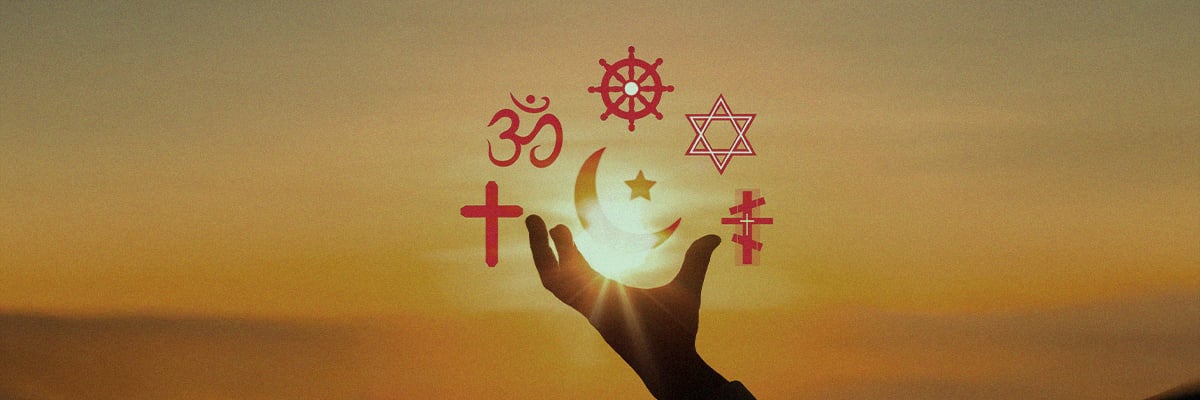

“Why not create a religion of our own?”
A fair question. An attractive idea! But the moment we move it from theory to practice, the entire plan collapses into a storm of chaos.
Humans are complex beings. Each person is a world unto themselves—driven by conflicting thoughts, desires, and needs. Life is tangled with triumph and tragedy, joy and despair, war and peace. For as long as we have existed, we have wrestled with profound questions: What is the origin of existence? What is the meaning of truth? What lies beyond death? Sit two people together, and they will never agree on answers to these timeless mysteries. To assume that humanity, with its infinite diversity of thoughts and experiences, can collectively create a universal and comprehensive religion is nothing short of delusion.
THE COLLISION OF IDEAS
Global society is a battlefield of competing values and contradictory beliefs. What one person holds sacred, another ridicules. What moves one heart may appear nonsensical to another. If humanity were tasked with creating a singular, all-encompassing moral code—one that smooths over every disagreement and unites every divergence—it would unravel before it even began.
Yes, humans can craft inspiring stories, captivating myths, or even a company’s bylaws. Laws and constitutions are drafted with a footnote: “Subject to revision as needed.” But a moral framework that transcends time, borders, and cultures—one that applies equally to all—cannot be built by our fickle hands.
To construct such a system requires someone who knows us better than we know ourselves.
ALCOHOL: A CASE STUDY
Take alcohol, for example. There is no ambiguity about its harms. Beyond a momentary sense of euphoria, alcohol wrecks the body, clouds the mind, and tears apart the fabric of families and societies. Any rational person can see its destructive consequences.
Now, imagine humans gathered to write a moral code. Would they unanimously decide to ban alcohol outright? Hardly.
Remember, alcohol is a multi-billion-dollar industry. For those who profit from its sale, human health and family stability are irrelevant. All that matters is profit. The history of the alcohol trade is littered with mafias, cartels, and corporate giants who defend their interests with ruthless resolve. Today, the forms of addiction have only multiplied—new substances, stronger doses, clever marketing—creeping into schools and homes, poisoning minds and bodies alike.
If humans write the rules, a few voices may call for restraint. But they will be drowned out by the thunderous roar of industry. Against such forces, who can stand firm and declare with authority: “Avoid it completely!”
THE EXPLOITATION OF DESIRE
Consider adultery, prostitution, and the commodification of the body. These are as old as history itself. Today, society sanitizes these practices with euphemisms— “sex work,” they call it—normalizing what was once seen as moral decay. But who benefits? Behind the polished facade lies a world of exploitation, violence, and despair.
The unseen engines of powerful economies are often lubricated by the trade in human bodies. Wealthy elites—respectable by day, indulgent by night—are complicit in the same system they publicly condemn. Who, then, has the courage to say: “Do not even approach adultery!”?
Certainly not those with vested interests.
THE TYRANNY OF INTEREST
Now consider interest-based economics. The global financial system thrives on interest—on the backs of the poor who sink deeper into debt while the wealthy grow richer. Shakespeare’s Shylock may be a fictional character, but his cold, cruel demand for a pound of flesh reflects a reality we still live in.
Interest is the lifeblood of modern economies, but at its core lies exploitation. No matter how sophisticated its mechanisms or how persuasive its justifications, interest ensures that the rich remain untouchable while the poor remain enslaved. Who among us can stand up and declare, without compromise or hesitation: “Interest is forbidden!”?
Not humanity. For even those who suffer under its weight are complicit in its perpetuation.
HUMANS AND THEIR LIMITS
We do not need grand theories to understand this. Look within yourself. How many wild desires lurk in the shadows of your mind—desires you would never voice aloud? Every human carries them. It is only the existence of strong moral boundaries that restrain us from becoming slaves to those urges.
Imagine a school where the students decide the rules: What time should classes begin? How long should they last? What subjects should be taught? A gentle breeze or a light rain would be enough to justify a day off. Left to their own devices, those children would create chaos—not because they are malicious but because they are children.
We are no different. Left to our whims, we would fail to govern ourselves with fairness or wisdom.
A HIGHER SOURCE
That is why our moral code cannot come from ourselves. It must originate from a source beyond human limitations—one that understands the depths of our nature and the complexities of existence.
Religion, then, is not merely a set of dry statutes to govern daily life. It is a sacred, timeless philosophy that addresses the most profound layers of human existence. It cannot be fluid, bending to the whims of changing eras and ideologies. It must be firm, comprehensive, and enduring.
THE FINAL WORD
The human condition is fraught with contradictions. We crave indulgence yet seek order. We cherish freedom yet need boundaries. We desire meaning yet lose ourselves in the meaningless.
Religion is the answer to this paradox. It does not imprison us; it liberates us—from chaos, from exploitation, and from our basest instincts. It calls us to rise, to restrain, and to aspire to something far greater than ourselves.
To reject religion in favor of a human-made moral system is to place trust in the very beings who cannot govern their own desires. It is to hand the reins of a ship to those who cannot navigate the storm.
No, humanity cannot write its own laws. For that, we need a source beyond ourselves—one that knows us, guides us, and perfects us.
Without it, we would be lost. With it, we find purpose.
The choice is clear.