
From the moment word spread—“The Messenger ﷺ is coming”—Yathrib (Madinah) began to wait for its honored guest. Day after day, after the dawn prayer, groups would walk out to the outskirts and climb the rises, facing the road from Makkah. They would stand there until the sun grew fierce; if a sliver of shade appeared they shifted and kept their vigil. When the heat became unbearable and no shade remained, they returned home, only to repeat it the next morning.
It was a Monday in Rabīʿ al-Awwal. They had kept watch until the day blazed white and were drifting back when a Jewish man climbed to the top of his roof. From a distance he glimpsed a small caravan moving across the plain. He shouted at the top of his voice, “O people of Arabia, your fortune has arrived! He is here—the one you have been waiting for!” The city poured out in joy. In the desert fringe they met the Prophet ﷺ. He and his companions had already drawn their mounts to a halt beneath a patch of shade. Abū Bakr, roughly the Prophet’s age, stepped forward to receive the crowd, while the Prophet ﷺ sat quietly to one side. Those who came first mistook Abū Bakr for the Messenger; then the sun sharpened again and Abū Bakr raised a cloak to shade the Prophet ﷺ, and only then did they realize who he was.
They led him to Qubāʾ, the elevated quarter of the city, and he entered the house of Kulthūm ibn al-Hidim—some said Saʿd ibn Khaythamah’s home, though the first report is stronger. Reconciling both, some historians wrote that Kulthūm received the people in Saʿd’s house, for Saʿd—unmarried—hosted the bachelors among the emigrants. Abū Bakr lodged nearby with Khu bayb ibn Isāf.
Imām Aḥmad and others narrate: once at Madinah’s outskirts, the Prophet ﷺ sent for Banū al-Najjār—his maternal uncles through ʿAbd al-Muṭṭalib’s mother. They came armed in courtesy to escort him. “Enter in safety, as our leader,” they said. He mounted his she-camel Qaṣwāʾ, the people walking on both sides, some on foot, some mounted, voices rising in takbīr: “Allāhu akbar—God is greatest! The Messenger of God has come!” Children and servants climbed rooftops and called to one another, “The Messenger of God has reached us!” Anas (ra) remembers running with the throng, echoing the takbīr without yet seeing him—until the caravan paused behind a wall, waiting for the Anṣār to receive him. Soon five hundred of them arrived, repeating, “Enter in safety, as our leader.” The whole city seemed to tremble. Women leaned from the upper stories and asked each other, “Where is the Messenger? Where is the Messenger?” Madinah had never before, nor after, witnessed a scene like it.
Anas (ra) also reports—recorded by Aḥmad and Abū Dāwūd—that Abyssinians performed with their spears in celebration as young and old together offered blessings. And the song the people of Madinah composed that day still rings through the ages:
Ṭalaʿa al-badru ʿalaynā / min thaniyyāti’l-wadāʿ
Wajaba ash-shukru ʿalaynā / mā daʿā lillāhi dāʿ
Ayyuhal-mabʿūthu fīnā / jiʾta bil-amri’l-muṭāʿ.
The full moon has risen over us
From the valley of Wadaʿ;
Gratitude is due from us
So long as any calls to God;
O envoy among us, you have come
With a law we gladly obey.
With his arrival, Madinah shone. Abū Khaythamah swore the city had never known such radiance. Every household invited him home; some listed their conveniences, eager to host him and his guests. The Prophet ﷺ answered gently, “Leave my she-camel to her course; she is commanded where to kneel, and where she kneels, I shall alight.”
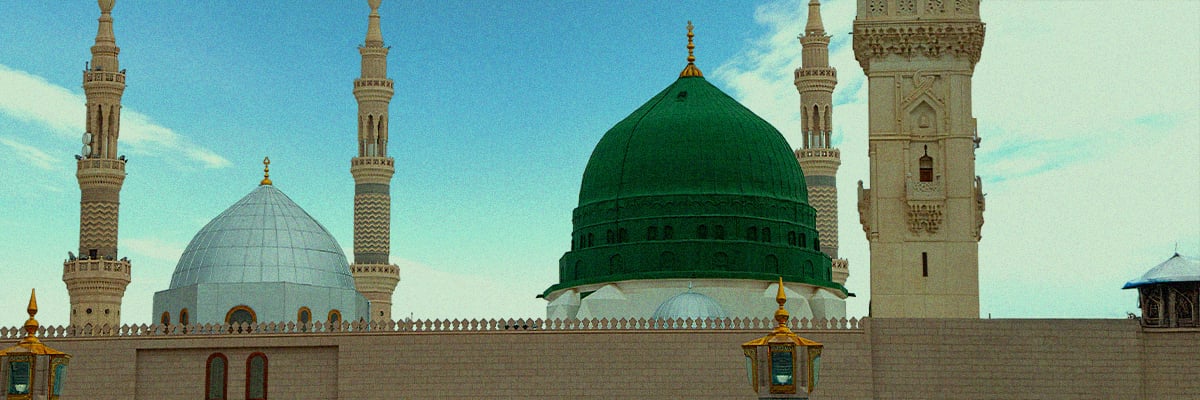
He stayed four days in Qubāʾ, from Monday until Friday, the 12th of Rabīʿ al-Awwal. Then he set out. Qaṣwāʾ came to her knees on the very ground where the Prophet’s Mosque stands today.
Upon entering Madinah, he offered special supplications: “If God wills, here is our dwelling.” He recited, “My Lord, cause me to land a blessed landing, for You are the best of those who bring to land” (Q 23:29). Then he prayed, “O God, I have come from the land most beloved to me to the land most beloved to You—so bless us here! Grant to this city blessings like those You gave Your beloved Abraham in Makkah, and more besides.”
He asked whose house stood nearest the spot where the camel had knelt. Abū Ayyūb (ra) called out, “O Messenger of God, this is my home—the camel has stopped at my door.” “Then prepare a place for us,” the Prophet ﷺ replied. Abū Ayyūb al-Anṣārī led him in. Little girls from the neighborhood came with hand drums and sang:
Naḥnu banātun min Banī’n-Najjār,
Yā ḥabbaḏā Muḥammadun min jāri!
We are the daughters of Banū’l-Najjār—
How blessed to have Muḥammad as our neighbor!
The Prophet ﷺ smiled. “Do you love me?” he asked. “Yes!” they cried. “God is my witness,” he replied, “I love you”—and he said it three times.
Abū Ayyūb’s house had an upper floor. When the Prophet ﷺ arrived, they offered him the upper level, but he chose the ground floor: “It is easier for visitors,” he said. The hosts, however, found no rest above him, fearful every footstep might disturb the Messenger below. One night, their water jar spilled; panic-stricken, they mopped it with the only cloth they had—a cherished blanket—lest a drop seep through the ceiling onto the Prophet’s ﷺ head. They did not sleep until dawn. When he learned of it, he acceded to their pleas and moved upstairs.
Their devotion colored even the table. When food was served, Abū Ayyūb and his wife would seek the place the Prophet’s ﷺ hand had touched, hoping for its blessing. One day they prepared a dish with onions; it returned untouched. “O Messenger of God,” Abū Ayyūb asked, “you have not eaten? We usually vie for the portion you touch.” The Prophet ﷺ answered kindly, “I speak often with people; its odor burdens them. As for you, eat.” They did—but never again cooked onions in that house.
After Abū Ayyūb’s passing, the home came to his servant Aflah, who sold it to Mughīrah ibn ʿAbd al-Raḥmān for a thousand dinars. Later it was purchased by Shihāb al-Dīn al-Ghāzī, son of Nūr al-Dīn al-Zankī, and turned into al-Madrasah al-Shihābiyyah, then, by the thirteenth century AH, into the Sāwiyyat al-Junayd. Today, it lies within the southeastern precincts of al-Masjid al-Nabawī.
Yathrib had been the city’s first name, attributed to Yathrib, a descendant of the Prophet Nūḥ (as). The Prophet ﷺ renamed it Madinah—“the city.” Al-Bukhārī relates from Abū Hurayrah that the Prophet ﷺ said: “I was commanded to go to a town that consumes (overcomes) all other towns. People call it Yathrib; it is Madinah. As the bellows expel impurities from iron, so will Madinah expel its wicked.” With his coming it became Madinat al-Rasūl, the City of the Messenger. As God sanctified Makkah, He sanctified Madinah. In a ḥadīth in Muslim, the Prophet ﷺ said: “Abraham sanctified Makkah; I sanctify Madinah.”
The Prophet’s ﷺ years in Madinah unfold in three movements. First: from the initial organization and proclamation to the Treaty of Ḥudaybiyyah—year six of the Hijrah—when a community took root and spread its message. Second: from treaties with enemies and the unmasking of conspiracies to letters inviting kings to Islam, culminating in the Conquest of Makkah in year eight. Third: from delegations arriving in waves and people entering the faith in crowds to the Prophet’s ﷺ farewell year—year ten—and his passing. Through all three, the lamp first lit in Qubāʾ cast its light across the world.


_1777358421433.webp&w=3840&q=75)