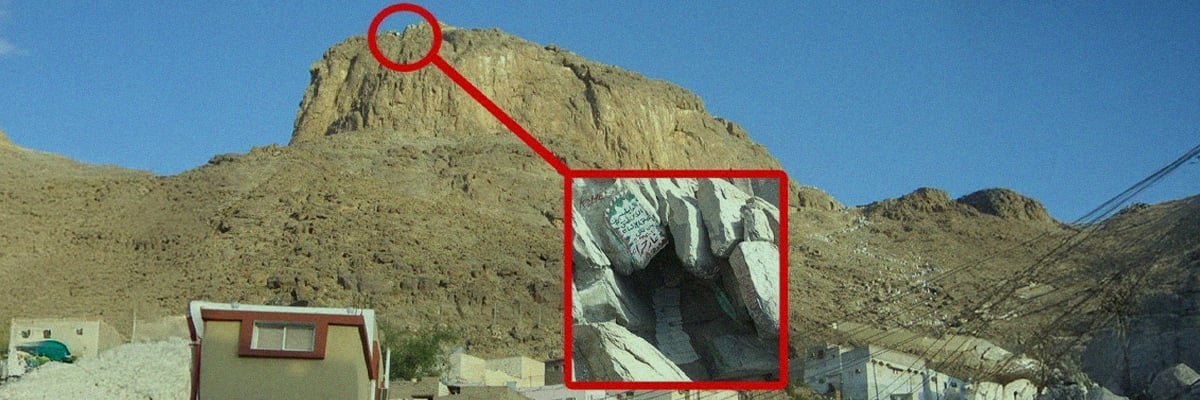

It was the fourteenth year of the Prophet’s ﷺ mission, the 27th night of the month of Ṣafar. That night, the Messenger of Allah ﷺ and his companion al-Ṣiddīq set out from Makkah, their steps turned not northward toward Madinah, but south, toward the rugged heights of Thawr. They knew Quraysh would search first on the road to Yathrib; to Thawr they went, three kilometers from the Kaʿbah, to find shelter in a cave on its summit.
They walked in the stillness of night. Abū Bakr was restless in his care—sometimes hurrying ahead, then falling behind, now moving to the right, then to the left—his eyes always searching. Was danger waiting on the path? Was anyone following? He made his body a shield for the Messenger ﷺ at every step.
Quraysh’s plot had collapsed, and they felt deceived by their own cunning. The Qurʾān would later recall that moment in Sūrat al-Anfāl (8:30):
“Remember when the disbelievers plotted to imprison you, kill you, or expel you. They planned, and Allah planned. And Allah is the best of planners.”
At last, the two reached the cave. Abū Bakr said: “Messenger of Allah, wait here a moment. Let me enter first. If any harm awaits inside, it will befall me before you.” He stepped in, inspecting every crevice. Where small holes gaped, he tore strips from his garment and stuffed them tight. When one opening remained, he pressed his foot over it and invited the Prophet ﷺ to enter. The Messenger lay his head on his companion’s lap and rested. There, in the cave of Thawr, the Prophet of truth and the Companion of truth found repose.
Relief filled Abū Bakr’s heart as he watched the Prophet ﷺ sleep, but then a sharp pain seized his foot. Something from the hole beneath was biting him. He did not move, fearing to disturb the Prophet’s rest or let the creature escape into the cave. Tears welled from the agony and fell upon the Prophet’s face, waking him. He asked what had happened, and Abū Bakr explained. Lifting his foot, they found a snake had struck. The Prophet ﷺ comforted his friend, applied his blessed saliva to the wound, and prayed for him: “O Allah, grant my Companion in Paradise the same rank You grant me.”
Meanwhile in Makkah, Abū Bakr’s children, ʿAbdullāh and Asmāʾ, were faithfully carrying out their duties. By day, ʿAbdullāh mingled in the city, listening, gathering news of Quraysh. At night, before dawn, he would climb to the cave with his reports. Their freedman ʿĀmir ibn Fuhayrah would bring the flock past the cave mouth, providing milk and covering their tracks. Asmāʾ prepared food, tying the parcels with the belt torn from her waist. For this, she became known as Dhāt al-Niṭāqayn—the woman of two belts. When she brought provisions to the cave, the Prophet ﷺ blessed her.
Quraysh, furious at their failure, scoured the land in search. At length their trackers came close to the cave itself. The entrance lay in plain sight; a single careful look could reveal those within. But Allah veiled them with simple signs. A spider had spun its web across the mouth. Doves had nested nearby. In some reports, even a green plant had sprouted. The pursuers saw these and said, “If Muhammad had entered here, the web would not be unbroken, nor the birds so calm.” They turned back.
Inside, Abū Bakr trembled. “Messenger of Allah,” he whispered, “if they look to their feet, they will see us.” The Prophet ﷺ, tranquil in prayer, replied, “What do you think of two with whom Allah is the third? Do not fear, O Companion. Allah is with us.”
The Qurʾān enshrined that moment in Sūrat al-Tawbah (9:40):
When the disbelievers drove him out, and he was but one of two in the cave, he said to his companion: Do not grieve, for Allah is with us. Then Allah sent down His tranquility upon him, strengthened him with forces you did not see, and made the word of the disbelievers lowest, while the word of Allah is supreme. And Allah is Mighty, Wise.
Thus they remained in the cave for three nights, while Quraysh scoured the desert. Then came the time to move. They needed a guide skilled in hidden paths. They hired ʿAbdullāh ibn Urayqiṭ, a man of Banū Dīl, not a Muslim, but honest and knowing every trail. Two camels had already been entrusted to him. On the third day, he brought them to the cave’s mouth, ready to lead the Prophet ﷺ and Abū Bakr toward Madinah.


_1777358421433.webp&w=3840&q=75)