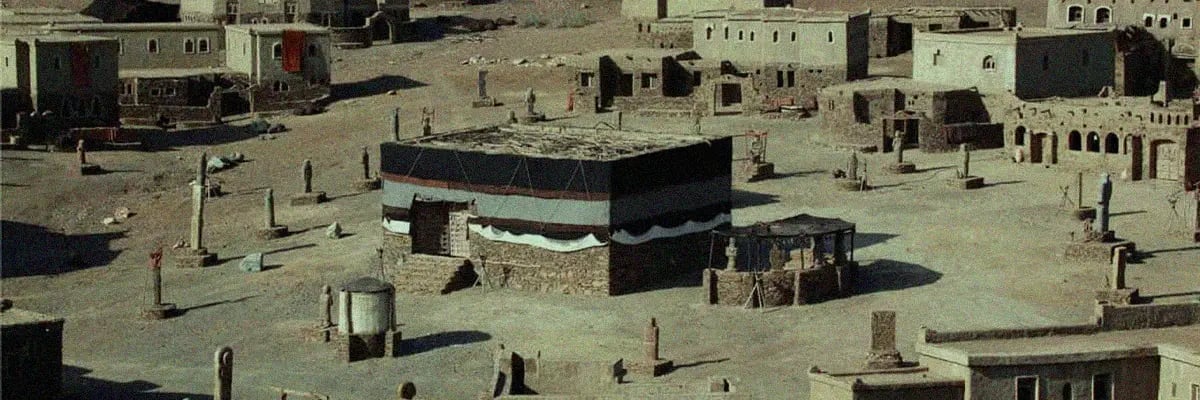

Most of the believers who fled from Makkah to Madinah did so in secrecy, slipping away quietly by night. But ʿUmar ibn al-Khaṭṭāb thought differently. Sword drawn, quiver full, and weapons strapped, he walked straight to the Kaʿbah. Before the Quraysh leaders who sat in their circles, he performed seven rounds of ṭawāf. Then, standing behind Maqām Ibrāhīm, he prayed. When he had finished, he turned to each of their gatherings and declared:
“Let the one who wishes his mother bereaved, his wife widowed, and his children orphaned, come and meet me in the valley beyond. There we shall see whose hand prevails.”
ʿAlī would later say, “No one dared rise to face him, nor follow him out.”
ʿUmar’s son ʿAbdullāh recalled one particular attempt at migration. “Ayyāsh ibn Abī Rabīʿah, Hishām ibn al-ʿĀṣ, and I had agreed to flee together from Makkah to Madinah. We fixed a meeting place at Tanāḍub, near Sarif. If two of us arrived and the third did not, we would understand that he had been captured. At the appointed time, I came with Ayyāsh. Hishām did not arrive. Later we learned he had been seized and imprisoned. Ayyāsh and I set out alone.
“When we neared Madinah, Abū Jahl and al-Ḥārith ibn Hishām (who later embraced Islam) caught up with Ayyāsh. They said, ‘Your mother has sworn oaths—she will not comb her hair until you return, nor sit in the shade until she sees you again. Go back with us at once!’
“The words of his kinsmen tugged at Ayyāsh’s heart. He wavered. ʿUmar warned him: ‘Do not fall for their trick. They mean to drag you back and harm you. When your mother feels lice biting her scalp, she will comb her hair. When the desert sun scorches her, she will take shade. Do not ruin yourself for this.’
“But Ayyāsh was guileless and believed Abū Jahl. He said he would go back, take leave of his mother, and collect his property. ʿUmar pressed him: ‘Let your wealth go. I am not a rich man, but half of all I own I will share with you. Only, do not return with them.’
“Ayyāsh still resolved to go. At last ʿUmar said, ‘Then at least ride my swift she-camel. If treachery comes, you will be able to break away.’ He agreed.
“But on the road Abū Jahl feigned hardship. He said, ‘Our mount is weak; let us ride with you.’ When Ayyāsh allowed them, they overpowered him, bound him, and carried him captive back to Makkah. Abū Jahl shouted to his people: ‘Here is the fool who fled us! We have dragged him back. Do the same with any who escape you!’ Ayyāsh was thrown into a roofless prison, chained beside Hishām.”
It was then that verses of the Qur’an were revealed, in Sūrat al-Zumar (39:53–55):
“Say, O My servants who have wronged themselves, despair not of the mercy of Allah. Surely Allah forgives all sins; He is All-Forgiving, All-Merciful. Turn back to your Lord, and submit to Him before punishment overtakes you, and you find none to help you.”
ʿUmar said, “When these verses came down, I wrote them on a tablet and sent it secretly to Hishām ibn al-ʿĀṣ. He later told me: ‘When I received the letter at the city gate, I could not at first grasp its meaning. I prayed to Allah to open it to me. Then I read again, and it struck me: these words are about us! I went straight to my camel, mounted, and rode until I reached the presence of the Messenger of Allah ﷺ.’”
Ibn Hishām preserves another strand of the tale. While the Prophet ﷺ was in Madinah, he asked his companions, “Who will aid me for the sake of Ayyāsh and Hishām?” Al-Walīd ibn al-Mughīrah’s son rose and said, “I will, O Messenger of Allah.” He recounted:
“I journeyed to Makkah, entering in great secrecy. By chance I saw a woman carrying food. ‘Servant of Allah,’ I asked, ‘where are you going?’ She said, ‘To two prisoners.’ I followed her until I knew their place—a roofless chamber. That night I scaled the wall, crept in, and with my sword broke their shackles. I set them on my camel and we fled. Along the way I noticed blood trickling from their feet. They looked at their wounds and murmured: ‘You are but a small finger, bleeding in the path of Allah.’ We pressed on until we reached Madinah, and stood before the Messenger ﷺ.”
Migrations to Madinah continued—some in secret, some in the open. The Quraysh tried to stop them by every means. When Suhayb al-Rūmī attempted to depart, they intercepted him. He was wealthy. They said, “Did you not come to Makkah as a poor foreigner? Was it not here that you grew rich? By Allah, you will not take that fortune away with you.”
Suhayb asked, “If I leave you all my wealth, will you let me go?” They agreed. Gladly he abandoned everything and walked away free. When the Prophet ﷺ heard, he said, “Your bargain has profited you, O Suhay


_1777358421433.webp&w=3840&q=75)