
Eleven years had passed since the Prophet ﷺ first declared his mission. Then came the night of the twenty-seventh of Rajab—a night of divine consolation in the midst of relentless trials. It was the night on which Allah, the Lord of the worlds, invited His Messenger ﷺ to the highest realms, granting him the vision of His presence. The journey by night (Isrāʾ) and the ascension to the heavens (Miʿrāj) left the Prophet ﷺ profoundly moved.
In the brief span of that wondrous night, he journeyed from Makkah to Bayt al-Maqdis in Jerusalem. This was the Isrāʾ, the very event after which the seventeenth chapter of the Qur’an is named. Its opening verse proclaims: “Glory be to Him Who carried His servant by night from al-Masjid al-Ḥarām to al-Masjid al-Aqṣā, whose precincts We have blessed, that We might show him some of Our signs.” From Bayt al-Maqdis, the Prophet ﷺ ascended upwards into the heavens—al-Miʿrāj. The opening verses of Sūrat al-Najm (53:1–18) point to this sublime ascent.
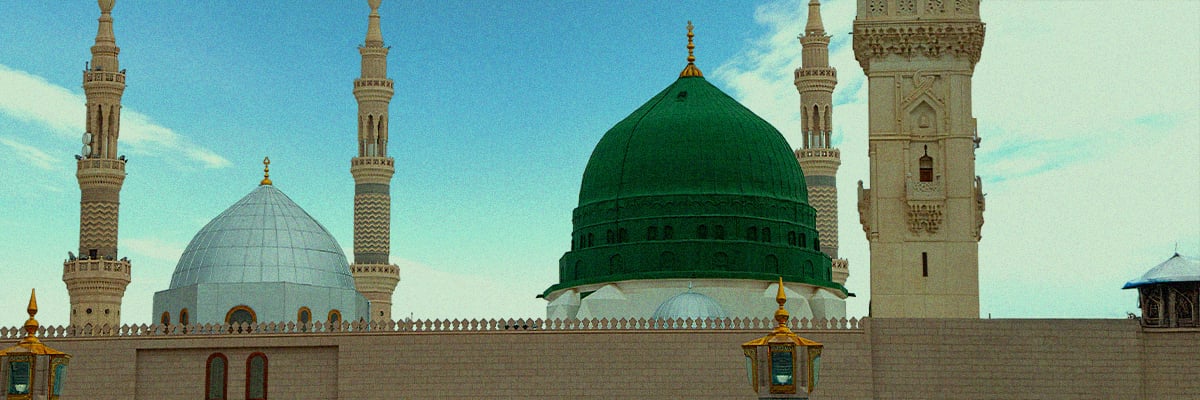
From al-Masjid al-Ḥarām, Jibrīl carried him upon al-Burāq, a celestial mount swifter than lightning. At al-Masjid al-Aqṣā he led all the prophets in prayer, a sign of his role as the seal of prophecy. From the rock within the precinct—the very place over which the Dome of the Rock now stands—he was lifted skyward.
At the gate of the first heaven, Jibrīl sought entry. There the Prophet ﷺ met his father Adam, who welcomed him with greeting. On Adam’s right were the souls of the blessed; on his left, the wretched. At the second heaven, he met ʿĪsā and Yaḥyā, who embraced him with affection. At the third, he beheld Yūsuf, radiant with beauty. Higher still, he encountered Idrīs and then Mūsā, who wept—saying, “A young man sent after me will have a following greater than mine.” At the seventh heaven stood Ibrāhīm, leaning against the Frequented House (al-Bayt al-Maʿmūr), visited daily by seventy thousand angels who never return again until the end of time.
Then the Prophet ﷺ was borne to the Lote Tree of the Uttermost Boundary (Sidrat al-Muntahā), where the divine decree descends and from where the angels do not pass. He heard the pens inscribing destiny upon the Preserved Tablet. At the highest nearness, he was honored with intimate discourse with his Lord. He offered salutations of praise; Allah returned greetings of peace. Among the gifts bestowed was the command of fifty daily prayers.
On his descent, he met Mūsā again, who urged him to ask for ease, saying, “Your community will not bear it.” The Prophet ﷺ returned to his Lord nine times, until the obligation was reduced to five prayers, carrying the weight and reward of fifty. When Mūsā again urged him to ask for further reduction, the Prophet ﷺ replied with reverence, “I am ashamed to ask more. I accept and submit.” Thus, five prayers became the eternal pillar of the faith.
During the ascent, the Prophet ﷺ was also shown visions of the punishments awaiting sinners: adulterers, usurers, those who devoured the wealth of orphans. These scenes imprinted upon him the gravity of justice and accountability.
After the journey through the heavens, he returned with Jibrīl to Jerusalem, mounted al-Burāq, and rode back toward Makkah. Along the way, he passed a caravan of Quraysh merchants. He saw one of their camels carrying two sacks—one black, one white. The animals stirred in fright at his presence, and he gave salām to the caravan. Some thought they recognized his voice. Before dawn broke, the Prophet ﷺ was back in Makkah.
The next morning, he encountered Abū Jahl, who mocked him: “Any news, Muḥammad?” The Prophet ﷺ replied, “Yes. Last night I was taken to Bayt al-Maqdis.” Abū Jahl scoffed: “And you returned here before dawn?” When the Prophet ﷺ confirmed, Abū Jahl called out loudly, summoning the people: “Come, O sons of Kaʿb ibn Luʾayy! Listen to what Muḥammad claims.” The Prophet ﷺ repeated his account before them. Some laughed, others clapped in disbelief, some put their hands on their heads in derision. Yet the Messenger ﷺ spoke without hesitation or doubt.
They pressed him: “Describe Bayt al-Maqdis for us.” Though he had never seen it before, Allah placed its image before him. He described its doors, windows, stairways, and distances in detail. Each time he spoke, Abū Bakr declared: “You have spoken the truth. I bear witness you are the Messenger of Allah.”
The people then tested him further: “Our caravan is returning from Syria. Did you see them?” The Prophet ﷺ answered with precision: “Yes. Yesterday I saw them at al-Rawḥāʾ. They had lost a camel. I saw it. Upon its back were two sacks—one black, one white. By now they are near Tanʿīm. They will reach Sanīyyat al-Balad on Wednesday.” They waited. On Wednesday, as the day waned, the caravan entered. The people verified every detail—the lost camel, the vessels—yet still they turned away, calling it sorcery.
For Abū Bakr, however, this moment sealed his rank. When the people mocked, “Do you believe he went to Jerusalem and back in a single night?” Abū Bakr answered: “Yes. And I believe something greater—that revelation descends upon him from heaven. If I accept that, why should I doubt this?” From that day, he was named al-Ṣiddīq—the steadfast confirmer of truth.


_1777358421433.webp&w=3840&q=75)